Tuesday, December 26, 2023

SATYA INTERCONNECT CABLES


 Over the many years I've been producing amplifiers and pre-amplifiers I've often been asked to recommend interconnects .

I tend to decline to do this as I just don't think there are a lot of interconnects that are either good value, or do what they are supposed to do. 

There is so much hype around interconnects and speaker cables- its possible to spend thousands on interconnects , for little discernable improvement in sound quality.

There are some preposterous claims made for some of these expensive cables , and they can certainly sound different .

Mostly because they have been engineered to act like a filter or tone control , but this is not the purpose of a good interconnect.

A good interconnect will let the signal through and do nothing more and certainly nothing less. 

It will allow the excellent frequency and phase responses of a good preamp to travel unhindered through to the power amp , with no detraction or addition to this signal.

It will be quiet ,  providing a barrier to any external hum or interference.

Presenting the Supratek SATYA interconnect , a high quality, high value interconnect that will do exactly what it should do , maintaining a perfect transmission between preamp and power amp.

The SATYA is constructed from a twisted pair of teflon jacketed, solid core , silver-plated pure copper cables. 

This is the same wire that I use in the Supratek preamps , so it will be a perfect match for the Supratek, and indeed any preamplifier.

 It has a copper shield over the twisted pair for shielding purposes and a plastic covering over the shield for durability. 

Quality Amphenol connectors. 

                                                                   Construction detail


The SATYA will match any cable for performance and will be a great partner for your Supratek Preamp. 

Aligning with the Supratek reputation for extraordinary value for money the SATYA costs $100 for a pair of 1.2 metres cables .

Also available in custom lengths at an extra $10 per 150mm extension.

Also available in balanced XLR configuration.

Please send email to supra@supratek.com.au to order. 


Wednesday, December 13, 2023

DUAL GRANGE WITH 12SX7 TUBES.

 The 12SX7 tube is a 6SN7 with a 12 volt heater , as opposed to the 6SN7's 6.3 volt.

Its been tested to have the lowest distortion of any 6SN7 , and sounds very good, with attributes beyond current production 6SN7 tubes, and amongst the very best NOS tubes.

I have a stash of unopened General Electric 12SX7 tubes, enough to build 4 Grange preamps with spares.

The first one will be a Dual Grange. This configuration has two line level outputs, both with the famous Supratek quality. 

This enables the use of a subwoofer, or for use in a bi-amp system.

As an example, one of my systems is a three way, with a 15 inch bass , a midrange horn and a tweeter horn.

The bass driver is driven by a solid state amp, which is connected to one of the Granges outputs, with level control to adjust gain.

The mid and tweeter horns are connected to the other Grange output, also with a level control.

The crucial mid range is driven by a wonderful 2A3 single ended amp, the tweeter with a small Class A solid state amp.

With a powerful amp on the bass , and a tube amp that is very synergistic with the mid horn i get the best of all sounds, and the abilty to do very fine adjustments to the overall balance , this is critical to getting optimal sound in each individual room, and to suit taste.

A master voume control sets the overall sound level.

Crossovers are passive on each driver, I personally prefer this to active crossovers, many speakers are bi-amp capable, which means the internal passive crossovers can be connected to seperate amps.

Ive been using this bi-amp method for many years , as  I find it is quite superior to one amp driving multiple drivers. Impulse or transient recovery speed is much improved. 

In such a system 2 or 3 reasonably priced amps will easily outperform an uber expensive high end amplifier.

The Grange preamp is built in a 1.2mm copper chassis with Australian Jarrah hardwood cabinets.

It has a state of the art tube phono stage designed for moving coil cartridges, which uses very high quality frame grid tubes designed at the end of the tube era - these are ideal for phono stages which need low noise and linearity. 

The line stage of this particular Grange uses 4 x 12SX7 tubes as noted above.

They are run conservatively,  and will last many years. A spare set of boxed tubes is included.

There are 10 expensive Lundahl transformers in the preamp, along with high quality components. 

The power supply is separate from the preamp and is the key to the superlative performance.  

It has a power transformer that is strong enough to power a big tube amplifier,  with seperate constant current source and tube regulation for each of the phono and line stages, so 4 in total.

40 years of tube design and build experience results in a tube preamp that is as fine as can be built , a custom built unit that will provide a lifetime of musical bliss.

This individual preamp will be available sometime in January 2024. 

Expression of interest to supra@supratek.com.au 


Thursday, August 24, 2023

DHARMA LineStage


Just in time for Xmas '23 the time is right to announce a new Supratek product- the Grange Signature Linestage.

For the first time, a Supratek product won't be named after a wine variety - I've decided to call this preamp DHARMA, which is Sanscript for TRUTH . 

Appropriate I think , as this is the finest preamp I've built .

Based on the Grange Signature, the DHARMA is minus the phono stage, but has the same linestage circuit using 1944 NOS 6J5 tubes and the same power supply with constant current source tube regulated circuit.

The best linestage I've ever built, and the NOS 6J5 tubes are wonderful preamp tubes.

Combined with the Supratek Signature circuit , this preamp is warm and natural sounding, and yet still so insightful and revealing. 

Its the preamp to end your days with and the feedback from Dharma owners is very positive and rewarding.

Its only available with 6J5 tubes or if a Dual version is required (for biamping) it can be built with NOS 6SN7 tubes.

A spare set of boxed 6J5 tubes are supplied (4) which will last many decades.


Saturday, July 8, 2023

SUPRATEK MERLIN

 Many years ago I made a Single Ended amplifier that bordered on the ridiculous. It measured  650mm by 650mm (one monobloc channel) and required two men to lift it. 


The text from my web site said:

"The V1505 and it's equivalent the 212E has been described as the ultimate audio valve. 
An imposing 270 mm high and 90 mm in diameter it is a spectacular tube by any standards. 
A valve of this quality demands  preceding driver stages and power supplies of the highest calibre. 
I decided that I would make absolutely no compromises in any way in the design and building of this amp. Each monoblock amplifier (two for stereo!) measures 650 mm x 650 mm. 
There are 5 power transformers, 4 chokes and 5 signal-circuitry transformers on each chassis. 
It is finished in hammertone silver and black and with the Ediswan V1505 valve alight is a beautiful statement of industrial art. 
It certainly causes comment and wonderment from all who view it.
CIRCUITRY  I chose what I believed would be the best valves for each section of the amplifier- a 3A/167(WE437) for the input stage( but recently went back to a SRPP 6SN7 ) transformer coupled to a 1930's vintage, directly heated 50 valve as the driver, transformer coupled to the V1505. 
I don't know why transformer coupling sounds so good; it may be the oldest method of coupling valves, but it's re-emergence as the premier audio coupling device is long overdue. (Thanks to Mr Shishido and Mr Sakuma) 
It has been suggested that transformer coupling's low harmonic distortion is partly responsible for it's sound. 
The output transformer is a Japanese Tango, very expensive- very good! 
The power supply uses four U19 directly heated rectifiers for the V1505 plate supply, buffered by a GZ37 in the ground rail for soft start. Another GZ37 provides voltage for the 3A/167 and 50 and a 6X4 provides adjustable bias for the V1505. Each V1505 and 50 can be kept in perfect bias with individual bias controls and meters."

It performed very well, both on the oscilloscope and to the ear, but it exhausted me building it, and it was so impracticable that I didnt build a matching monobloc for stereo.

But it was a good learning vehicle,  and I resolved to one day build a more practical version.

Over the years I assembled the parts needed and I am very close to putting everything together.

First, let me explain the naming of this extraordinary amplifier.

The amp uses very ancient and extremely rare tubes that were designed for and used by both the British Royal Air Force (RAF) and the Royal Australian Air Force (RAAF) as transmitting tubes in their military aeroplanes.

Around the same era, Rolls-Royce made the monstrous 12 cylinder Merlin motor which was famously used in the Supramarine Spitfire fighter airplane which figured prominently in the Battle of Britain during the Second World War.

The Merlin motor was used in other fighter and bomber planes and was even used in some USAF fighters, including the Mustang.

Putting  such a huge motor into the relatively small frame of the Spitfire really highlights the engineering expertise of that era, and explains the amazing performance of the Spitfire,  due to its very high power to weight ratio.

There are very few Spitfires still flying, and likewise very few of the tubes I'm using in this amplifier are now available,  so the name Merlin appeals to me .


This will be a long project , hopefully taking around 6 months to build, and I will do regular updates on the progress as I go along.

If you are interested in the truly exotic , and an amplifier that is so rare and unique that only one set of monblocs will ever be built , then please enjoy the journey.

So to start, the Merlin will be a single ended amp of around 40 watts. 

Lets firstly get into a description of the tubes used .

The input tube is the STC made, Northern Electric branded 4310A . STC (Standard Telephone Company) was the British arm of Western Electric (WE) which initially used Western Electric designed tubes before they become more independent from WE.

The 4310A is the same as the WE 310A , a pentode tube used in the famous 1930's era WE91 amplifier, which used a 310A driving a WE300B triode. Fabulous tone.


The 310A drives an AWA branded (Amalgamated Wireless Australia) VT25 triode.

This tube is so rare that its been almost impossible to even find the correct documentation for it.

VT25 is normally the military designation for the number 10 triode , a very old 1920's triode which later evolved into the 801A.

There is also a VT25A , which starts to get confusing , but these versions are well documented , and while they are getting expensive , still obtainable. 


The Australian tube I'm using has a box plate much bigger than a 10/801A which suggests its an entirely different tube, desite it having a VT25 stamp on its base.

There are suggestions that it is a CV1025 . Documentation of the CV1025 claims a mu of 0.4 and Rp of 300 ohms. 

This is unlikely and its possible the tube is a DET25.


Using it in circuit will determine what it is, but regardless it will make a very fine driver for the output tube, which is the also very rare Ediswan V1505.

Similar to the WE 212E , this huge tube is a high voltage triode that can output high wattage single ended sound.

The minimum plate voltage for the V1505 is 1200 volts, which is getting into the scary side of voltages, good insulation and careful design and construction will be needed to ensure safe useage.


The output transformer needs to be of the highest quality to match the tubes used, and in keeping with the rare and expensive theme , I'm using a pair of Tango X-10S output transformers. 

These are designed for 211 triodes, and the 10k impedance is high for a V1505, but using an 8 ohm speaker on the transformers 16 ohm tap should be fine.

As I use high efficiency horn speakers I'm not after high power levels , and a higher load will deliver even lower distortion. 


Here's a mock up of the chassis , they are built in mirror pairs so this is the left channel.

Power transformer and chokes to go alongside the output transformer.

There will be a pair of ammeters and a level control in the 3 round bevels on front panel. 

Transformers and some other bits to arrive, come back in a month or so, to see how I'm going.


And in stereo.


Friday, June 30, 2023

Why Do Supratek Preamps Sound So Different (And Good!)

I wanted you to know I'm bowled over with the Cabs performance. I love it, its without doubt the best Ive heard my system, not to mention the cosmetics! There's something special going on in my system now, the Levison 27 loves every bit of the Cab as I do!!"

"Awesome, thank you so much for the clarification. It sounds magnificent either way and I'm thoroughly enjoying the experience"

The Supratek preamps must have the best customer satisfaction rating , just about every customer reports nothing but total satisfaction with the sound of a Supratek in their system. 

These comments are from this weeks completed preamps , but I have many hundreds of email reports just like this one. So what makes the Suprateks so different to any other tube preamp?

Design 

Firstly, its all about design. I've been doing this for 40 years now, and there isnt a tube preamp design I haven't tried over the years. 

The Supratek design has evolved over this period after many hundreds of designs were built and tested , which involved many thousands of hours listening .

They are over-engineered to be reliable and trouble free over the very long life you can expect from a Supratek preamp. 

The power supplies are massive and big enough to be used in a very competent power amp. 

Everything is geared towards the sound quality. While they may look like a million dollars , cosmetics are a secondary consideration - sound quality is everything and this comes from the circuit design . 


Construction

The second factor is the method of construction .  Its more than just point to point wiring . Every connection within the preamp is as short as possible , and its all hand wired so that each interconnecting component's lead wire is wrapped around the next connecting component.  

A solid electrical connection is made before solder is applied. In theory , the preamp would work without any soldering at all. 

No circuit boards are used for the preamp circuitry. 

Consider a preamp built on circuit boards , as 90% are.  All those holes into which components fit , have to be filled with tin/lead solder to make a connection. 

Every connection is made through a tin/lead connection , hundreds if not thousands of them.  There is no direct electrical connection between components , but through the multiple lead/tin connections.

People using circuit boards will tell you it makes no difference , I will humbly beg to differ.

Air Wiring . 

This is a very contentious issue and if the Supratek preamps have had any criticism over the years, its always been about the internal wiring.

Rather than 2-dimensional circuit boards , the preamps are hard wired with solid core wire that is done in 3 planes , its not bundled into the corners or kept in tight formations.

The reason for this is primarily to keep the wiring as short as possible and to have uncompromised connections in free space. 

This has a lot of advantages , primarily  IT SOUNDS BETTER.  I cant emphasize that enough.

You get a big 3D sound with a Supratek preamp,  there's nothing 2 dimensional about it , its transparent, open and believable  realism. 

Again, its the difference between circuit boards and hardwiring .

Another advantage is that repairs and trouble shooting is very easy for a person who has a little knowledge of tube circuits. 

Every connection can be easily traced and recognized. 

These days technicians won't even look at a repair without a circuit diagram, and a repair almost always involves changing a circuit board for a new one , if it is available. 

The Suprateks are an evolved design that is state of the art tube design, but it is not overly complex  , or complicated with unnecessary, sound degrading extras such as digital volume readouts , or complex switching arrangements. 

They are designed to last decades, and many Supratek preamps are into their 3rd decade of use. 

Most of the bigger components in the preamps are held in place with silicone adhesives.

I believe there is a definite sonic advantage to this , probably due to resonance control, maybe also some magnetic eddy advantage .

Its actually just as strong as nuts and bolts . All the big aluminium buses you see on the highways, and ferries on the sea have their bodywork held together with silicone adhesives these days. 

Components.

My website's article on  Buying a Tube Preamp covers this pretty well. 

This is just a short extract from it:

Audiophile capacitors, NOS tubes, “super” volume controls.
When a manufacturer makes a bigger deal out of available options than he does on the actual design of the preamp, be worried.
The design and construction of the preamplifier is far more critical and important than having the option of putting profit driven components in to a preamp.
The quality of the components used is important- paper in oil capacitors do sound different to polypropylene capacitors , but the difference is far less than the difference between a good circuit design and a poor outdated design.
A tired and unimaginative design from 1950 fitted with expensive capacitors will not come close to a modern, innovative design with good quality capacitors.
Similarly ,  you can spend a lot of money on volume controls, but you will never get a “better” sound than from a good quality Alps Blue pot. Different maybe, but certainly not better.
Circuit design and implementation is the beginning and end of quality sound.
Digital volume readouts might look nice, but in a tube preamp?  No thanks.


Zen and the Art of Tube Preamps.

Back at the start of my tube passion I was heavily influenced by the Japanese designer/builders- Shishido, Sakuma , Shindo and others who published in the Japanese MJ magazine , well before the internet came along. 

Shishido was more western orientated then Shindo and Sakuma who were more into "tone" . They didnt care much how a piece measured as long as it sounded "gorgeous" on their "full range" single driver speakers . 

Shishido did take measurement into account, and while he wasn't fixated on it, his amps had to measure ok as well as sound very good, which they did. 

Regardless of their approach , these guys loved building and listening to their work, they were artisans , with a real passion for what they were doing .

Never in a hurry, never compromising , never influenced by fashion or consumer demand , their sole intention was to get the maximum satisfaction and enjoyment from their tube equipment. 

I like to think I have the same philosophy and have employed the same criteria throught my Supratek career.

I certainly would have made a lot more income had I been sensible and used circuit boards and employed workers to assemble them into my products. 

But idealism is satisfying , and the high satisfaction rate and many hundreds of happy testimonials over the years is reward enough.

Would you rather have an amplifier built by one person with many years of experience, who loves what he is doing , or built by a nine to fiver who doesnt really want to be there? 

Sakuma was very big on the "spiritual" aspect of design and build - a  ZEN attitude  if you will. 

Does this make a difference to the actual sound realized? 

I think it does , and it certainly guarantees a better designed and built product.


Wednesday, March 22, 2023

More Supratek Grange and Musings.


                                                            Reimars White DHT 300B Grange 

My finest preamp - the Supratek Grange is perhaps the most distinctive tube preamp you can buy, but I'm most proud of the engineering that goes into them. 

It's the end product of decades of designing high gain transformer coupled preamps. 

The phono stage is especially interesting -  its an ultra high resolution moving coil gain stage - what comes out of the grooves is literally frightening , no warm, romantic tube sound here, its amazing how much information is in a vinyl groove , and the Grange phono brings every last piece of information. 

Sizzling highs, solid complete bass, but still with some tube magic to enhance the realism.  

The Linestage ideally compliments the phono stage ,  The Supratek sonic signature is famous for its 3D soundstage and "big" imaging .

Wherever possible , all tubes are NOS , the tubes used in the Signature linestage are from 1944 manufacture , even the boxes they come in are a work of engineering art! 


Because they take so long to make - nearly a thousand hand wired joints ,  the Granges are made in very limited numbers, but I do enjoy building them, they are mostly a labour of love and its a joy to turn them on for the first time and connect them to a turntable .


                                                                       Johnny's DHT 45 Grange 


                                                               Toms Signature 6J5 Grange


                                                                Piers Chrome Signature


On another tack completely, I had to waste some time recently while getting my car serviced so I bought a hi fi "annual" magazine and sat down in a cafe to read it . Frankly, I found it a bit depressing ,  lots of equipment that was ridiculously overpriced , and most of the cost deployed towards fancy metal casework. And designs based on technical correctness rather than reproducing music. 

Admittedly , the magazine was geared towards advertising revenue , and the reviewers mostly biased towards whatever is new and the latest thing. 

Its interesting , and rewarding to me, that most of the Grange owners are guys who have been into audio for a long time , and have seen through all the bullshit and smoke of the hi fi "high end" . 

They know what they want and its almost always a musical realism, rather than a "hi fi" sound that is always in need of an upgrade.

And they invariably have very good turntable/phono setups and high efficiency speakers. 

It was a bit sad to read in the magazine of the high number of lower efficency speakers being built these days .

I've written before of my disdain for low efficency speakers so I wont repeat myself, but I would like to 

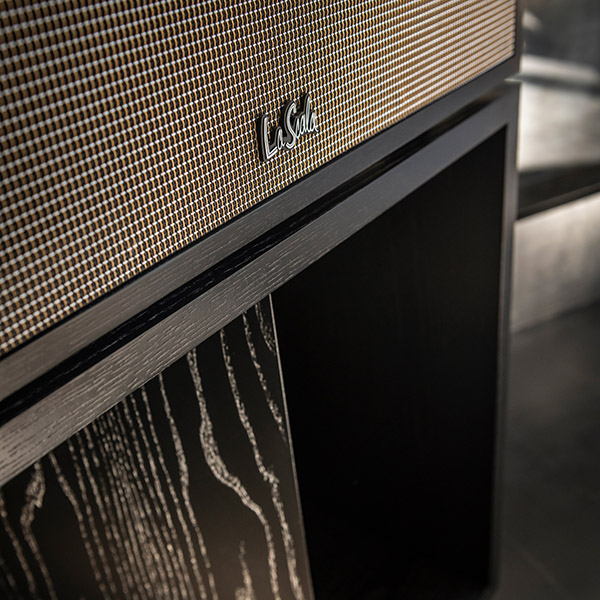
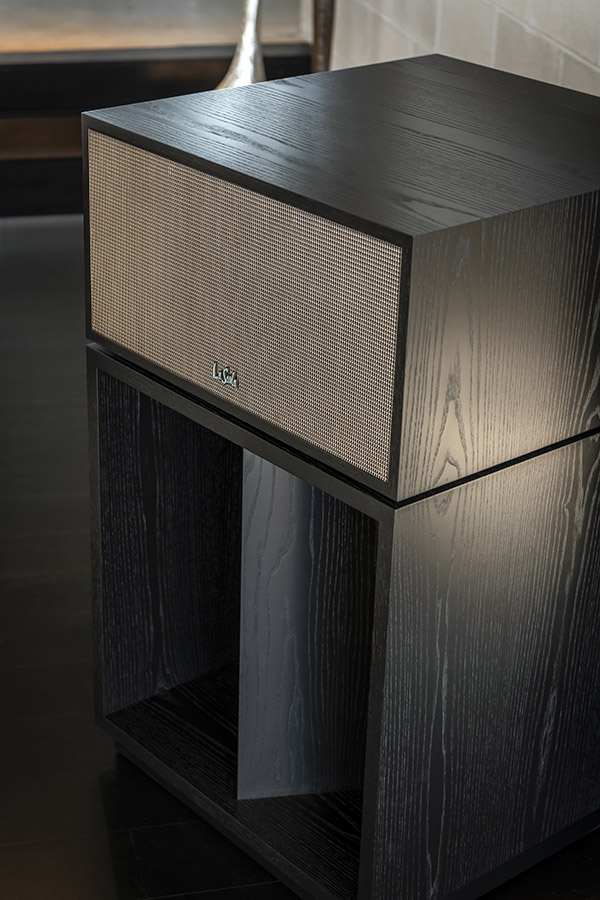
copy a review from Stereophile magazine on the Klipsch La Scala speaker. 

Not so much for the review on the speaker , which does have  flaws, but for the reviewers comments on the positive  benefits of high efficiency speakers.

Of course not everyone can accommodate high efficiency speakers are they are always large and domineering in typical rooms,  although progress is being made in making them more room friendly. 

For those with lower efficiency speakers, a good high gain tube preamp , such as the Suprateks, will give you more than a hint of the ease and presence of a HE speaker.

Its all about dynamics , and that is perhaps the Suprateks finest ability. 


In the rewview below I've highlighted the points I concur with and I've also included the article the reviewer alluded to after it. 

Note that this was written in 2002 , but its still very pertinent today. 


Klipsch La Scala AL5 loudspeaker

facebook sharing button
twitter sharing button
flipboard sharing button
pinterest sharing button
email sharing button
sharethis sharing button

There's a good case to be made that the world's greatest—and strangest—audiophile culture resides in Japan. Probably the most important notion the Japanese have introduced to our hobby is that home audio isn't merely a way of heightening the musical art of others but can be an art in itself. This idea's most flamboyant embodiment was the poet, journalist, chef, and amplifier builder Susumu Sakuma, better known as Sakuma-san.

After having built many amplifiers as a young man, Sakuma-san experienced an epiphany: Amplifiers that measured well often failed to make him feel deeply. He soon discovered that, for him, the most emotional sound came from mono systems powered by transformer-coupled amplifiers that used directly heated triode tubes.

In 1968, somewhat improbably, Sakuma-san opened a restaurant in the quaint seaside town of Tateyama. The eatery, called Concorde, was crowded with amplifiers of his design, which he demonstrated with a Garrard 401 turntable, a damped Grace tonearm, a Denon DL-102 mono cartridge, and Altec and Lowther speakers. Apparently, Concorde also served food: For years, the sole dish prepared by Sakuma-san was "hamburger steak," which came with two sauces and cost around $10.

In the articles on hi-fi that he contributed to the Japanese magazine MJ, Sakuma-san also wrote about film, fishing, karaoke, and pachinko machines, and he usually began and ended his contributions with a poem. He considered himself an evangelist for emotional sound and demonstrated his audio systems in homes, at conferences, and on concert stages around the world. Though he passed in 2018, his fan club, called Direct Heating, remains a happening concern (footnote 1). Sakuma-san was fond of coining mottos—one was "farewell to theory"—but what has stuck with me most is his description of the ideal sound: "endless energy with sorrow."

Living with the Klipsch La Scalas
This phrase came to mind often during the months I spent living with the Klipsch La Scala speakers, which imbued my musical life with unprecedented amounts of sound and emotion, and which I believe Sakuma-san would have enjoyed. Despite what some of the glossy ads, in this magazine and elsewhere, would have us believe, no speaker can excel at every aspect of musical reproduction. All of them, even the megabuck ziggurats, are a compromise. Yet what the La Scalas do well is so rare in today's audio scene, and so fun, that everyone should experience it at least once. Their strengths also happen to dovetail neatly with my musical and sonic biases. It goes without saying that these biases may not be yours.

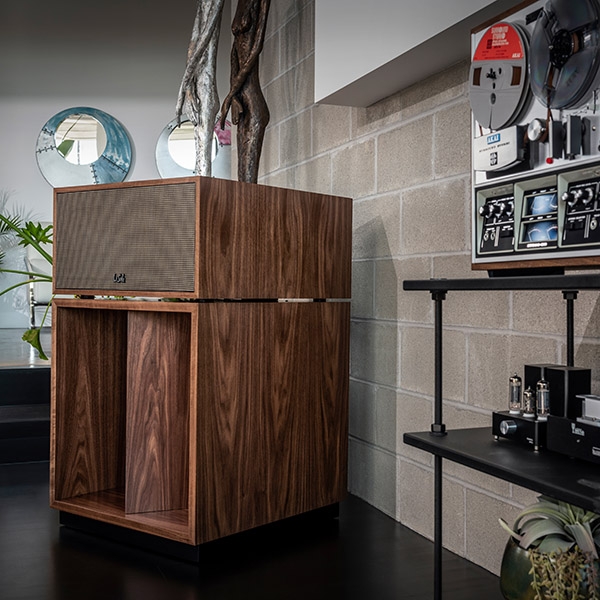
First introduced in 1963 as a public address speaker, the La Scala, now in its AL5 iteration, is the smallest of Klipsch's fully horn-loaded models, a little sibling to the venerable Klipschorn (with which it shares its three drive units) and the newer Jubilee. Of course, it's not even remotely small: Each speaker, made of birch plywood and MDF, measures 40" tall, 24 ¼" wide, and 25 5/16" deep, and weighs 201lb. (Just typing that number sent a twinge through my lower back.)

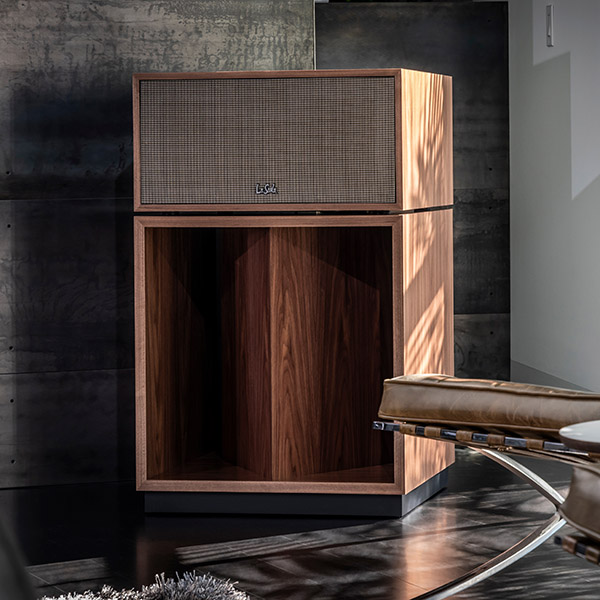
The La Scala is composed of two stacked sections. The upper cabinet contains the tweeter—a compression driver with a 1" polyimide diaphragm mated to a Tractrix horn—and the midrange unit: a compression driver with a 2" phenolic diaphragm mated to an exponential horn. Both horns are made of ABS plastic. The lower cabinet contains a 15" fiber-composite-cone woofer that's mounted backward and fires into a folded horn (which some would argue is in fact a waveguide). The rear of the upper cabinet has two sets of heavy-duty binding posts, allowing for biwiring but not biamping.

Mercifully, assembly was not nearly as odious as I expected thanks to the La Scala's modular structure and the bass cabinet's substantial rubber feet, which made moving the speakers surprisingly easy. Assembly does require two people, and one part—holding the upper cabinet while connecting its wire harness to the lower one—requires three, as I learned after much grunting, awkward contortion, and foul language.

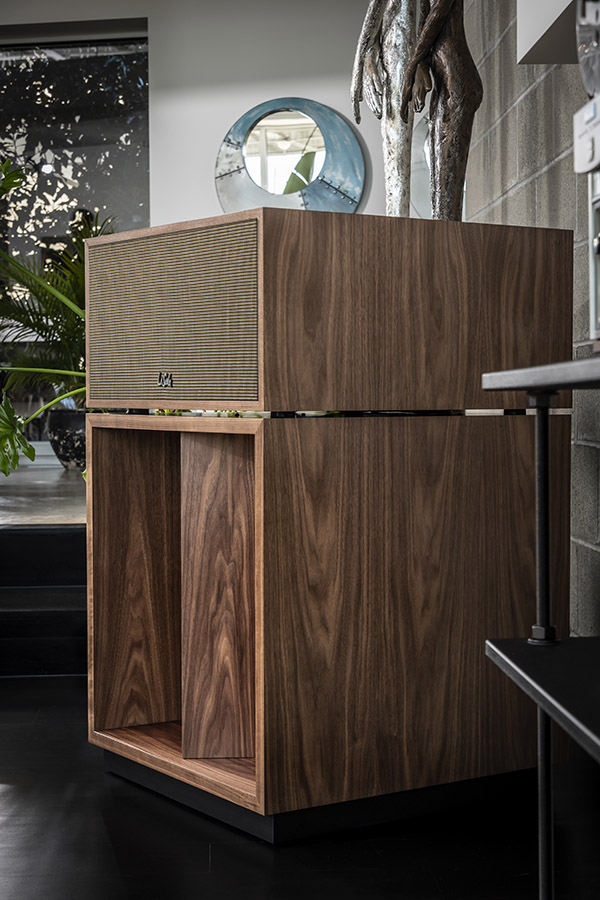
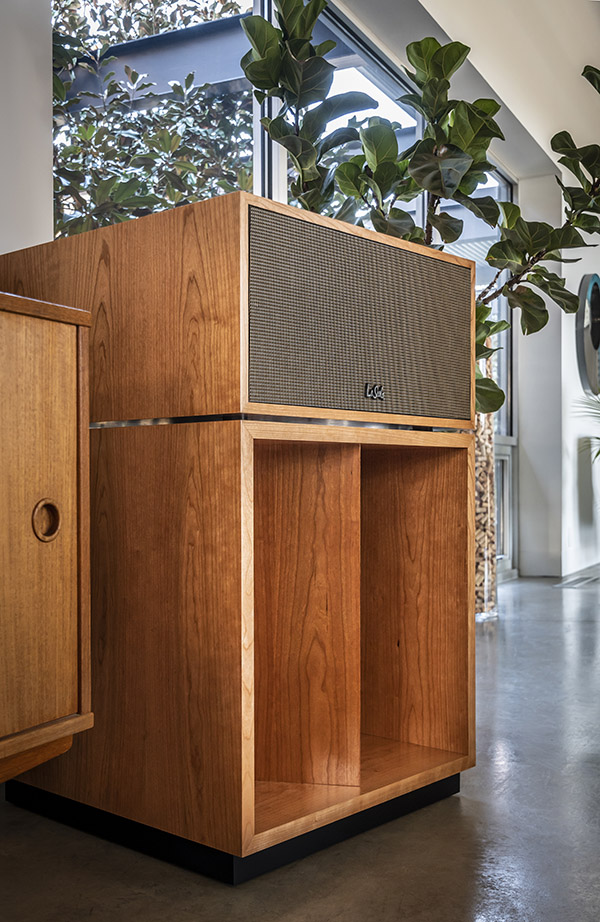
Despite the La Scala's boxy form—roughly the size and shape of a washing machine at a big-city laundromat—I found its appearance delightful. The book-matched walnut veneer on the pair I auditioned was seamlessly applied and beautifully finished, making the $13,198/pair La Scalas appear more heirloom-worthy and furniture-like than many pricier alternatives. Even the magnetic grilles, done up in a guitar-amp mesh and sporting vintage-looking logos, were conceived with enough restraint to look cool. Nothing comes off quite as pandering and corny as retro styling done wrong, and Klipsch should be commended for hiring astute designers.

The manual offers assembly illustrations and one solitary paragraph of text. Reading it, I learned that 1W of power will cause the Klipsches to emit a hair-raising 105dB, roughly the amount of noise made by a Douglas DC-8 at one nautical mile. (110dB is the average human threshold for pain.) I also spotted a diagram suggesting that the La Scalas should be placed 13'–17' apart, a recommendation I found a bit laughable given that most of us don't live in a Greyhound terminal or aboard Jeff Bezos's superyacht.

In practice, the La Scalas proved to be fairly forgiving about placement, though they sounded bloated when pushed against a wall and a little bass-light when pulled more than a few feet into the room. Some internet commentators suggest toeing them in 45° and crossing them in front of the listener, but in this position they sounded pretty awful. The Klipsches ended up working best roughly in the same spot as my Altec Valencias: 8½' apart, 2½' from the front wall, and some 10' from the listening seat, toed in to cross slightly behind it.

Listening
When the folks at Klipsch offered to send me a new pair of La Scalas for review, I requested that the speakers undergo several hundred hours of use before they were shipped, but this proved impossible. Straight out of the cartons, they had a plasticky, nasal sound and gummy transient response; with low-power tube amps, they refused to make much bass at all. Happily, all of this went away after about 100 hours of use. Patience is something I struggle with, and I admit that I came to some incorrect conclusions about the Klipsches before those long hours elapsed.

Oh, and about those neat-looking grilles: Music sounded more open without them, so regretfully I left them off.

The La Scalas offer a fundamentally different experience than most audiophile speakers. Their ability to (re)produce lifelike dynamic contrasts and scale is unmatched by any speaker I've had in my home, and matched by few speakers I've heard anywhere (all of which were larger). Once most speakers reach a satisfying volume, they allow a fairly limited range of additional loudness before they begin to compress, sound grainy, or distort. With the La Scalas, that range was practically limitless: I could set the volume anywhere from Mozart-trio moderate to Mastodon-concert loud with no audible penalty. In part that's because horn loading allows not only for increased sensitivity and efficiency but also for drive units to operate at lower levels of distortion.

The Klipsches created sonic images that were eerily, entirely life-sized and placed them on a stage as large as the recording and the room allowed. Combined with their hair-raising dynamic chops, this allowed the La Scalas to come uncannily close to creating the illusion of real musicians playing in a room. That's a big-time reviewing cliché, so perhaps a more effective way to communicate this is to say that they reveal how radically most speakers—even large ones—miniaturize the dynamics and scale of recordings.

I couldn't get enough of this illusion. Near the middle of "The Windmills of Your Mind," from Dusty in Memphis (LP Atlantic SD 8214), there's a moment when the band, the string section, the background voices of the Sweet Inspirations, and Dusty Springfield all surge. Played at a satisfying volume through most speakers, this crescendo comes across as a splashy, screechy mess. The La Scalas made me aware of the extent to which I had trained my brain to fill in the missing information; through them, I heard every detail of this passage, played at a loudness comparable to what the recording engineer must have heard at Memphis's American Sound Studio in September 1968.

The big Klipsches also allowed me to hear an array of meaningful detail with startling clarity: the reverb on Springfield's voice, her intakes of breath before every phrase, the mahogany chunk of Reggie Young's electric guitar, the coppery ring of Gene Chrisman's cymbal. These musicians appeared in front of me utterly human-sized, playing and singing in physical space with realistic force. With the right amplifiers (more on this later), the La Scalas also imbued this recording with copious presence, texture, and tone color, making it as lifelike and complete as I've heard it. (What I heard was an illusion in more ways than one: Springfield recorded her final vocals in New York and had them overdubbed. Aren't records great?)

If I'm making the Klipsches sound like a party speaker that excels only at playing loud, permit me to correct that impression. "Do they play opera?" Herb Reichert asked when I enthused to him about the La Scalas. That's a fair question given that they're named after the world's most storied opera venue. Listening to Boris Khaikin and the Bolshoi Theater orchestra and choir's rendition of the letter scene in Eugene Onegin (Spotify BMG Classics 74321170902), I was struck by the delicacy with which the big horns rendered this compressed mono recording from 1955, first issued on the Soviet Melodiya label. It happens to be my favorite version of Tchaikovsky's opera, with a radiant, 20-something Galina Vishnevskaya in the role of Tatyana and Khaikin taking the score faster than is common today, imbuing it with vigor and wit missing from more lugubrious readings. This nearly 70-year-old recording also showed off the Klipsches' buoyant way of carrying rhythmic lines, which sound as dancing or as relentless as the music dictates.

The La Scala is not without flaws, or more precisely, limitations. Surprising for a speaker of such ample proportions, it doesn't do really deep bass; its 15" woofer rolls off steeply at around 50Hz. Roy Delgado, Klipsch's chief audio engineer, told me that this is a result of a compromise that allowed Paul Klipsch to design a relatively compact bass horn. (The Cornwall, a smaller and less expensive sibling in Klipsch's Heritage line, dispenses with the bass horn and goes down to 35Hz.) Whether this deficit might be a problem for you depends on your musical diet and priorities. While I noticed bass missing on certain electronic music and hip hop recordings, I rarely missed it; some La Scala owners, though, use a subwoofer. I should add that, despite being limited, the Klipsches' bass is in no way wimpy: When called upon, the big horns emitted bass notes as stentorian and downright scary as any speakers I've lived with.

Last, while the La Scalas throw an enormous and cavernous soundstage, they do not create the razor-sharp sonic holographs of the kind conjured by certain contemporary minimonitors. But if that's crucial to you, you probably aren't considering these speakers.

In my room, the Klipsches' frequency response sounded just a shade richer than neutral, with an extended but mellow top end and some added presence in the lower midrange and upper bass. This euphonic voicing made poor recordings easier to listen to and good recordings propulsive and fun. I wouldn't change it for a flatter one, but frequency-response-graph enthusiasts for whom absolute neutrality is paramount should probably look elsewhere.


Footnote 1: You can learn more about Sakuma-san and his designs on the Direct Heating website: www.big.or.jp/~dh.

Klipsch La Scala AL5 loudspeaker Page 2

facebook sharing button
twitter sharing button
flipboard sharing button
pinterest sharing button
email sharing button
sharethis sharing button

The La Scalas' sound varies remarkably depending on amplification, and they demand and reward high quality; the prospect of them being driven by a big-box-store receiver fills me with sadness. Choosing the right amplifier to use with them wasn't entirely straightforward and required a fair amount of trial and error. The Klipsches' sky-high sensitivity may suggest otherwise, but a single measurement never tells the whole story. I listened to them with five amplifiers controlled by the superbly transparent and tuneful PrimaLuna EVO 400 line stage; here's what I heard.

Ayre AX-5 TwentyThe Ayre is a lush and musically compelling solid state amplifier, but through the La Scalas it sounded pretty analytical, buttoned-up, and dry. Though one shouldn't generalize from limited experience, I'm going to: The La Scalas love tubes.

Oliver Sayes SET with 307a output tubes: This fairly "tubey" sounding design, producing 6W per channel, emitted beautiful tone, but in this application it lacked resolution and sounded a bit gooey. And while it made copious bass, that bass was poorly defined and slow. The La Scalas seemed to want a more neutral tonal balance and more grip.

Western Electric 91EThe big Western resolved scads of detail and sounded both liquid and well-controlled. Well, nearly. On "Lively Up Yourself " from Bob Marley's Natty Dread (LP Island ILPS 9281), Aston "Family Man" Barrett's electric bass sounded a bit listless, lagging behind the rest of the music. And the 91E couldn't quite unlock the highest level of dynamic expression the speakers are capable of. To generalize again, those wishing to drive the La Scalas with a low-powered (sub-20W) tube amplifier, particularly of the single-ended persuasion, may not get stellar results. Try them together before buying.

Line Magnetic LM-845IAThe swaggering 22W made by the ferociously hot 845 triodes in this amplifier proved a fantastic match for the Klipsches. Barrett's bass notes landed like the jabs of a welterweight, and the recording danced and strutted in a most convincing fashion. The Chinese amp also created a smooth, utterly grainless sound with saturated tone colors and unraveled lots of ambient information without drawing undue attention to it in the manner of some more analytical amps. Wooo!

Manley Mahi Mahi: Especially in Ultralinear mode, with the negative feedback set to minimum, these push-pull EL84 monoblocks from EveAnna Manley succeeded in squeezing maximum dynamics from the La Scalas while imbuing recordings with gorgeous color, pace, and all the detail you might wish for. Compared to the Line Magnetic, they presented an even more propulsive, harder hitting sound, sacrificing just a bit of liquidity, texture, and presence. Another goosebump-inducing match.

Engagement
Now that you know something about how the La Scalas sound, you may be wondering about a more pressing issue: How do they communicate music? For me, sound quality and musical engagement are tied up most directly in the experience of dynamics: It's in the infinite gradations of intensity that intent and meaning in music are most acutely expressed. In "God Is in the Nuances," the most thought-provoking article I've read in this magazine, Markus Sauer (footnote 2) quotes (and somewhat awkwardly translates) French audio and music journalist Jean-Marie Piel, who describes this connection with more elan and poetry than I can muster:

"The essence of a [musical] interpretation lies in working on the infinitely small—be it an attack on a note held back for a fraction of a second (perceptible if the preceding note is reproduced neither too short nor too long), or be it a note that develops in itself; or, on a larger level, a crescendo or diminuendo encompassing several notes—all of which gives music a sense of direction, its palpable dynamics, its quivering life, and all of which, in the end, lies in the nuances.

"Which explains, by the way, why certain old loudspeakers with a very high sensitivity and thus a very high precision in the rendition of dynamics, especially of very small signals—just like certain tube amplifiers with very simple circuits—and despite more or less obvious colorations and the omission of an octave or two, manage to reproduce with disturbing fidelity all the emotional intensity of an interpretation. Which should give our designers something to think about, and convince them that the musically more important kind of dynamics is that which loses itself in silence, not the kind that turns into noise."

The La Scalas' remarkable sonic realism would be pointless if they weren't also masterful at revealing the "quivering life" Piel is talking about. Luckily, they excel at excavating the musical drama of a recording, allowing records to startle and engage with more regularity than the vast majority of speakers of any size and price. Through them the music breathes, shouts, and whispers.

I live in a loft, or essentially a single large room. On a recent morning, I put on a recording of Ali Akbar Khan playing Rag Alam Bhairav, a morning raga, as quiet background music while doing some stretching and working out. Though I was trying to focus on my stubbornly inflexible joints, I became so enthralled by the sarod's woody resonance and amber tone, and by the kaleidoscopic shadings of sound and meaning that Khan extracted from it, that I ended up sitting on the floor and listening to the music lunge and dance until the 28-minute track was over.

This level of engagement characterized my time with the La Scalas. After some listening sessions, I was so emotionally wrung out that I felt tired and needed to walk away from music for a while.

Last year, at Jim Austin's urging, I began a series of reviews to explore whether I could find what I loved about my 1967 Altec Valencias in a current-production speaker. The California-made Altecs excel at dynamic expression and scale, yet the larger La Scalas lap them in both categories, simply offering more. These speakers from Arkansas (whose design predates the Valencias) also energize my loft in a more satisfying way, perhaps due to their greater sensitivity and directionality. The Altecs, in turn, sound a bit more natural and reproduce drums with more snap and presence. They have a little more filigree and soul. Yet the La Scalas are even more adept at musical drama and spectacle and have proven second to none at making me turn off my phone and listen.

The Klipsch La Scalas have been in constant production for 59 years, longer than all but a tiny handful of audio products, and this is surely not an accident. (Happily, it also means that secondhand examples, available for a fraction of their current price, are relatively common.) They aren't perfect, and they require a large room and a suitable amplifier, but they offer the closest thing I've heard to a musical performance taking place in my home. They do this as reliably with solo viola as they do with Minor Threat. Best of all, they provide as direct a route as I've found to hours of musical engagement—to embodying what Sakuma-san described as "endless energy with sorrow," to which I would add love, rage, humor, and elation. $13,198 is an investment, but it will buy you some of the most sonically irrepressible and musically communicative speakers in the known cosmos. They just may sustain you for life.


Footnote 2: Markus Sauer was a valued contributor to Stereophile. Sadly, he passed away in 2015.—John Atkinson


God is in the Nuances

facebook sharing button
twitter sharing button
flipboard sharing button
pinterest sharing button
email sharing button
sharethis sharing button

This journal has seen a number of thoughtful ruminations on what it is that attracts us to music or to a given audio component, and how we should describe that attraction. The "Letters" pages have been filled by readers who have taken us to task for not adhering to rigorous scientific methods in the evaluation of components, those rigorous scientific methods usually being equated with double-blind listening. Other readers have praised the magazine for its stance that an educated listener in a familiar, relaxed environment will be more accurate in his or her assessment than an average of trained and untrained listeners in unfamiliar, stressful circumstances. Overall, sonic descriptions from diverse reviewers in different publications show a remarkable consensus of observation (not opinion).

The value judgments, however, differ to a much greater degree. One reason will be the differing horizons of experience. I would have more confidence in a reviewer's ability to place digital components correctly in a sonic hierarchy if he had auditioned a good proportion of the available gear than if he hadn't. The other reason seems to be that when two people hear the same system under identical circumstances, their appreciation of the system's balance of strengths and weaknesses will still differ. Their emotional reactions may well be radically different.

The truly troubling aspect of this oft-repeated observation is not that people react differently to the same musical stimulus---that's only to be expected. But when several listeners each play music they like on the system, their reaction should be more uniform. But it isn't. What irks me is that, while we seem to be able to agree pretty well on how a system sounds, there seems to be no consistency of emotional reaction to this sound, even though reaction to the same music played live would probably be reasonably consistent. Putting it another way, there is no easily ascertainable relation between component sound and emotional response.

Let me illustrate what I mean from my own experience. Several years ago, I had a Naim Nait II integrated amplifier in my system that worked quite well with the speakers I owned at the time, the Epos ES 14s. The ES 14's electrical demands, especially regarding current, could not be met fully by the low-powered (20W or so) little Naim, resulting in restrictions in loudness and dynamics, and a bass that could have been tighter. Yet this was, emotionally, a quite satisfying combo. At the time, I tried (for several weeks each) two pre-/power-amp combinations: the German one cost about eight times as much as the diminutive Naim, the American one about 10 times as much. Both amp combinations had been very well reviewed in the international press. The power amps had far superior control over the speakers, the bass went deeper, the treble was cleaner and more extended, the system went louder, I was hearing details the Naim had hidden---in short, the sound, as defined by the usual list of categories, was better in almost every respect.

Yet both combos left me emotionally cold. The degree of analysis these amps allowed was far greater than the Naim's, but music just didn't reach out and touch me anymore. Objectively, both combos were "better"; in a review situation, the expensive amplification obviously was experienced as observationally better, too. But so what?

This experience, which came at a time when I was first starting out as a reviewer, precipitated a minor crisis. Could I hear as well as a reviewer had to? Did I lack adequate experience in setting up demanding systems, and thus couldn't get the expensive combos to perform as well as they could? Were the speakers incompatible with the amps, or did the expensive amplification just tell me what was wrong with my front-end? In retrospect, I'm sure that my setup was at least adequate. I have heard the same amps under different conditions, in other systems, and could recognize the sonics as coming as close as possible, given different room conditions and source components, to those I had achieved in my own system. But I'm also convinced that my emotional reaction was correct. Both combos just weren't as well adjusted to my preferences as the integrated amp. But how could that be? Shouldn't more money buy you more audio fun?

Subsequent experience of a greater number of other components has shown me that, no, there seems to be no reliably observable relationship between price and musical satisfaction. The reason seems to be that it is possible to take components in different directions, optimizing aspects of performance that do count for me, and others that don't.

In the July 1994 Stereophile (p.19), I "outed" myself as a triode-and-high-sensitivity-loudspeakers man. For the last five years or so I've been trying to understand what it is that attracts me to their sound, but have yet to come up with a coherent answer. Let's not beat around the bush: Triodes and their paraphernalia go against almost every convention the High End has acquired in the last two decades or so. They don't have many watts, let alone a decent power bandwidth; their measurements are often abysmal; their high output impedance wreaks havoc on an unsuspecting speaker's amplitude response; being transformer-coupled, their phase response is much less flat than that of most decent solid-state gear; and it is extremely difficult to design a stable triode amp that doesn't use capacitors or transformers to decouple the amplification stages inside the amplifier, which means they won't be as transparent as really good solid-state stuff.


God is in the Nuances Page 2

facebook sharing button
twitter sharing button
flipboard sharing button
pinterest sharing button
email sharing button
sharethis sharing button

In the course of my convoluted thinking, I have begun to question, among other things, the current state of the art of hi-fi design and hi-fi journalism, and their impacts on the public's approach to component selection. I don't seem to be alone in this. I have found that there has been, in recent years, an undercurrent going in much the same direction of general unease with the state of the high-fidelity art. I have read many articles and think pieces, and heard many offhand comments, all of which indicate that others are searching just as hesitantly and erratically as I am.

There has also been an observation that kept bothering me. In the great objective vs subjective debate, Stereophile has done as much as any magazine to show that the objectivists' position is really untenable. That position can be summed up as follows: All important differences between hi-fi components can be measured; most differences that can be measured don't actually matter because they are below the limit of audibility, as proven by double-blind listening tests; thus, at least for amplifiers, all competently designed amps sound the same. This position---which seems to be a specialty of the American audio engineering establishment, at least---seems quickly on its way to extinction because it runs counter to the direct experience of anyone who takes the trouble to go into a dealer's for a demonstration.

Yet there are millions of people out there who buy what, in our enlightened eyes, passes as junk, as lo-fi or no-fi: rack systems, boomboxes, cynical mid-market efforts with a maximum of bells and whistles, and so on. If you demonstrate a high-end system to these people, sure, they'll hear the difference. But to the eternal dismay of high-end dealers and manufacturers alike, these people will not then go out and buy a decent system. They return to their modest home systems and are quite content with them, even though their ears have been opened and they now know that there are much better systems out there to be had.

In many cases this may be because these people's interest in music is not high enough to justify an expensive system. Yet we all know there are a lot of people out there who love music, have decent record or CD collections, make enough money, and still can't be bothered about the High End. The usual lament is that they have either been corrupted by the mainstream press or that they have cloth ears.

I'm not so sure about that. Because the reverse is also true: people with excellent home systems can listen to something as humble as a car stereo (a topic that has often popped up in Stereophile) and still have a profound musical experience. This, to me, indicates that even for those of us who do have considerable experience of really well-reproduced music, enjoyment is not necessarily linked to high-end sound. It seems that much of the high-end sound experience is just that: an experience of sound, not of music-generated emotion, and that many expensive high-end systems are not one iota better at generating a musical experience than all those down-market systems.

This heretical thought points the way to another question. We, the High End, typically tell the objectivists that if their measurements don't show a correlation between specs and sound, they must be measuring the wrong thing. Well then, if there is not much correlation between how a system sounds and the musical pleasure to be had from it, does it not follow that we are listening for the wrong things?

This is not intended to be an indiscriminate slashing of all things high-end---far from it. There are many components out there that satisfy musically. What I'm railing against is the fact that it's very, very hard to find out which these are from reading magazine reviews. Typically, the review runs through a list of sonic attributes, judges this or that aspect to be good, outstanding, or substandard, and then leaves the reader with the recommendation to go listen for himself. When you consider that many dealers don't seem to have a clue either, that's not really very useful.

The time has come to go back to first principles and put to the test the underlying assumptions that are taken as given in reviewing audio components.

Why do we listen to music?
Let's start with the basics. Why do people listen to music? There has been considerable musicological research into this subject, and the findings are clear.

Very few people listen to music to have their rational faculties appealed to. Bach's music may have been described as pure mathematics, but practically nobody would want to mathematically analyze the different tone pitches, tone intervals and harmonies, and so on. I mean, how many people do you know who, when they want to enjoy some music, will hook up their system to an oscilloscope instead of to loudspeakers or headphones?

The overwhelming majority listen to music for an emotional experience. You can use music to enhance moods or to counteract them. You can use music to provide a frame of reference and to literally set the mood during mass experiences; go to any concert, rock or classical, and your feelings will be deepened by the fact that many people around you are on the same emotional cycle (not for nothing is music used, in practically all cultures, in group bonding experiences, be they Sufi dervish ceremonies or football games). When you're blue, playing a blues album and sharing your loneliness and sorrow with the performer will comfort you. Dance music will project its infectious energy into you. Mahler will put you through the emotional wringer---first by being sad and grating, then by gently lifting you up to give you a token of hope. Mozart will entertain you with his lighthearted tunes. Supermarkets and fast-food restaurants play music for bringing you to a well-defined speed in your actions, be they eating (footnote 1) or wandering through aisles (footnote 2). And we all know that soft music can be an important part of setting the mood for gentle seduction.


Footnote 1: The presence of music can make as much as a 30% difference in a store's turnover.

Footnote 2: The restaurant doesn't want you to linger too long, when it could use your table to serve other customers. In the US, where the use of Muzak is much more prevalent than in Europe, patrons, when not pressed by time constraints, stay only about 60% as long in a restaurant as they do in Europe.

God is in the Nuances Page 3

facebook sharing button
twitter sharing button
flipboard sharing button
pinterest sharing button
email sharing button
sharethis sharing button

Music is not really a universal language; different cultures link the same music to different moods. But within a given culture it is an important nonverbal communication tool. What you may not be able to express in words, you may be able to share through music.

The original motivation behind the reproduction of music in the home, therefore, has been to facilitate access to the emotional aspects of music. When you make music yourself, your ability to express emotions will be limited by your talent, and by your proficiency on a given instrument (and boy, have I suffered in both respects). With reproduced music, these limitations are unimportant. I can have Led Zeppelin, Caetano Veloso, John Coltrane, Miles Davis, Tony Scott, Büdi Siebert, Stephan Micus, Aretha Franklin, or Alfred Brendel play for me whenever I like---heaven!

If this is the motivation, then it follows that the yardstick for judging a component's worth should be its ability to communicate emotion. Is modern technology getting us nearer our goal of emotional communication? Certain subcultures of the hi-fi community have long held that some historical components, even though they're hopelessly behind the sonic accuracy of modern components, have qualities that many modern components lack. Why do some amplifiers from the Golden Age of American hi-fi, such as the Marantz 8 or certain McIntosh models, continue to rise in value? Is modern technology evolving in the right direction?

Expert testimony
Jürgen Ackermann is a 37-year-old psychologist living in Frankfurt, Germany. He has long been interested in music and its reproduction, building amplifiers and speakers for himself as well as for some friends. His current home system includes a home-brew tube preamp, a home-brew single-ended triode power amp (the power in question being all of 2W from a single 2A3 per channel), and modified Klipschorns. This system is seriously loud when required, those sound bursts from Flim and the BB's Tricycle coming across as positively threatening---yet it whispers with a clarity and conviction most minimonitors fall short of. His amp is remarkable in that there is none of the hum that is generally unavoidable with direct-heated triodes. He has designed an indirect heating that relies on very precise balancing of voltages, and has made it work beautifully.

As part of his doctoral thesis, Ackermann researched the experience of music reproduction in the home. He conducted an experiment, setting up three systems in a room of the Frankfurt Hochschule für Musik und Darstellende Kunst (Music and Performing Arts University). The first system consisted of an analog record player, ca $4800, and a tube pre- and triode power-amp combination worth ca $4500 (hereinafter called the analog system). The second system substituted a respected CD player, ca $2400, which has been well reviewed worldwide, including in the pages of Stereophile, but retained the tube amps. The third system kept the CD player but was powered by a transistor pre-/power combination worth ca $11,000 (hereinafter called the digital system).

The components had been selected as being reasonably representative of their kind. The loudspeakers were held constant and had been selected for their ability to sound equally good driven by tubes or transistors. If anything, the system favored the expensive transistor combo, which had been selected because it was one of the best-selling combinations in its price range, and also because comparative listening tests against some other transistor amps had revealed this combo to sound particularly good in the test configuration. All three systems were played at exactly the same loudness level.

Ackermann found 53 people from all walks of life willing to participate in his experiment: hi-fi enthusiasts, musicians, and "normal" people with no special relation to music or its reproduction. The selection of participants was not truly stochastic, but the sample was large enough to give meaningful results.

Participants were seated in a room before a pair of loudspeakers. The part of the room behind the speakers was partitioned off with dense cloth so that the participants could not know what went on behind this curtain. Indeed, they had no idea what was going on or what, if anything, was changed between trials, except that they were going to be interviewed on their reactions to several pieces of music. Ackermann made the system changeovers without once interacting with the participants.

The participants were received and instructed by a student who was paid for her time. This student, who had no knowledge of things hi-fi, was instructed to sit behind the participants so she could not influence the participants even subconsciously. The student first gave the participants a questionnaire that asked for their musical likes and dislikes. A second questionnaire asked how the participants normally listened to music, and a third questionnaire tried to establish the emotional base level at which each participant entered into the experiment. These and all other questionnaires were standard forms developed for musico-sociological research, and had been pretested to be meaningful and easily understandable by the participants.

Then the participants were played a standardized set of three musical pieces. These were tracks from Larry Conklin's Dolphin Grace (light jazz), Sally Barker's This Rhythm Is Mine (pop), and Italian Violin Musik, 1600-1750 on Edition Open Window (baroque classical music). The tracks had been selected after a preparatory experiment showed that they gave meaningful results. None was offensive to the participants; strong individual likes or dislikes could not influence the experiment's outcome.

After the first run-through, participants were given three more questionnaires: one asking for their emotional balance (the same questionnaire as before the music began), one asking how the participants had experienced the musical tracks, and one asking for their opinions on these tracks.

Then the participants were played the same tracks on a different system, and again had to fill out the three questionnaires; and so on with the third system. The sequence of the three systems was randomized so that familiarity effects, or fatigue, could not influence the overall outcome.

After the third trial, the participants were asked to fill out, besides the three standard questionnaires, a final questionnaire asking whether they had a music system at home, what it consisted of, and how expensive the components were.

Finally, the participants were asked by the student which of the three still-unidentified systems they would buy. The student also took notes of the participants' behavior during the tests: Did they react to the music by moving their feet? Did they sit through the presentation, or did they talk or stand up while the music was playing? and so on.

The tests were not exhaustive, in the sense that further questions might have shed even more light on the subjects' response to the three systems. But, as each test took about two hours, it was felt that this was the maximum time that people without any interest in the outcome of the experiment would be willing to be subjected to the rigors of being under very close scrutiny (13 multi-page questionnaires to fill out---what a chore).

Care was taken to keep exterior factors constant. The listening room was not darkened, because it was felt that listening in a dark room would be too far outside everyday experience for most participants. It is well known that lighting conditions have an effect on people's mood (or why do you turn out the lights when you want to share a little intimacy with your partner?). To keep lighting conditions constant, the experiments were restricted to a time slot between around 10am and 2pm, which meant that only two or, at a pinch, three persons a day could be interviewed. The time of day at which each interview was conducted was noted; it will be interesting to see if there is a correlation between time of day and the results.

Giving the complete results of Jürgen Ackermann's experiment would be way beyond the scope of an article such as this one; besides, Ackermann has not yet completed his statistical analysis. But there are already some results that seem interesting enough to warrant a preliminary report (footnote 3).

Let's start with the emotional states of the participants. The participants began with a base tension level of 3.26; with the digital system this dropped to 2.35, and with the analog system to 1.75. Nervousness was raised from a base level of 1.8 to 2.2 by the digital system, but fell to 1.1 with the analog system. The need for relaxation fell from a base level of 2.6 to 1.9 with the analog system, but rose to 2.9 with the digital system. The ability to concentrate remained constant with the analog system at 4.3, but fell to 3.6 with the digital system. Relaxedness stayed constant with the digital system at 4.0, but rose to 4.6 with the analog system. This shows that the analog system worked toward a feeling of serenity in the participant, whereas the digital system heightened tension and stress.

Equally interesting was the response to the question of whether the participants liked the music they were played. With the analog system, 43 out of the 53 participants said they liked the Larry Conklin piece, 46 the baroque music, and 38 the Sally Barker piece. The music was heard as interesting, emotionally appealing, and engaging. Via the digital system, the levels fell to 31, 33, and 33, respectively. The same music was now more often experienced as boring. Food for thought.

The questionnaire asking for the listeners' experience of the music gave just as interesting results. Thirty participants sang along with the music under their breaths when it was played via the analog system, and only 19 with the digital system. Forty-seven participants said they had let themselves be carried along by the analog system, 19 with the digital system. When questioned whether the music had influenced their movements (tapping their feet, etc.), the numbers were 30 and 25. Forty-six participants had been inspired to think about the music by the analog system, 34 by the digital system. Forty-seven participants said the music had improved their sense of well-being via the analog system, 31 via the digital.

Conversely, no participant said that the analog system had impaired their sense of well-being, but 16 participants said so of the digital system! This must be one of the most astonishing, and irritating, results of Ackermann's experiment. How can it be that we spend a lot of money on something that makes us feel worse?!

The results of the "intermediate" CD/tube system were consistently between those of the digital and analog systems.

At the end of the test, the participants were asked which of the systems they would buy. Those listeners who had some experience of things hi-fi preferred the digital system, which they thought sounded better. Those participants without such experience preferred the analog system's sound. The conclusion Ackermann drew from this is that the sound of modern hi-fi is the result of a learning process. When told that a certain sound is what they should aim for, often enough people will accept this concept of sound as their internal reference.

Another inference that may be drawn from this question is that there was no correlation between what the participants experienced as good sound and which system made them feel good. In other words, the perceived quality of sound had no influence on whether the participants liked the music and its emotional impact on the listeners. One participant, a musician, even responded that he could hear absolutely no difference in sound between the presentations, yet his emotional response was very different on the three trials, and showed complete conformity with the rest of the participants.


Some of you will have noticed that there was one long-term test subject: the student who accompanied the participants during their time in the listening room. The poor girl had to listen to the above-mentioned pieces 159 times! At the end of the experiment, she asked Ackermann what the systems were. She said she couldn't stand the sound of one of the systems anymore, feeling physically attacked by its sound. By now, it won't surprise you that the system in question turned out to be the CD/solid-state one.

Let's put audiophilia on the couch!
If we accept that much of modern technology has been developing in the wrong direction, that there are many, many systems out there that may offer beautiful sound but that don't stand a chance of providing real emotional pleasure, the obvious question is Why? Why has something which, on the face of it, runs counter to the needs of the buying public, been so successful? I can't really believe the reason is mass delusion. I also can't see a great conspiracy between manufacturers, dealers, and magazines. ("Let's spend the next 30 years convincing the public to buy gear that will leave them emotionally unsatisfied. We may not sell as much as we could sell, but heck, what a power trip!") There must be a deeper reason.

I don't know what that reason is, but I'd like to present two ideas---one proffered by Jürgen Ackermann, one from my own experience---that might help shed some light on the mystery.

As I said, Ackermann is a psychologist practicing as a psychotherapist in Frankfurt. His approach is one of developmental psychology. One of his research models is constructed like this: When a child is born, it is living in symbiosis with its mother. When the umbilical cord is cut, the child is cut off from its life-support system and urgently needs to establish a new one, not knowing that there are social-security systems that will provide it with the basic necessities of life. The child experiences fear, the fear of dying. It will try to form an emotional bond with its parents, which is called love.

Many modern parents find it difficult to come to terms with the newborn. Emotionality is not something God-given, but must be learned. The child senses this reluctance; when it doesn't succeed with its love strategy, it must find a new one. The usual pattern is that the child will pay a price for food, shelter, and love. It behaves well, it's the joy of the parents, it will do as well as possible at school. At the same time, the child will have to find a new psychological pattern with its parents. Often it will idolize its parents, especially the mother. She's the best, the most beautiful, the most loving. This constitutes a new symbiotic relationship between child and mother. They live with each other but alongside each other, without really interacting in a way that might endanger their fragile balance.

The child will relate to other parts of its world in the same way, because this is the way that has been found workable. As a grown-up, such a person will also have an idealized view of, among other things, technology. He or she will not trust their feelings in judging a hi-fi component, but will rely on measurements or other objectifiable criteria. Thus, a new component is desirable because it represents an ideal: the best there is, the best in a certain respect, the best product in its price range (footnote 4) When the revered hi-fi system turns out to be emotionally unsatisfying, there are basically three ways to cope with it.

One of these patterns is a form of denial. One couple of Ackermann's acquaintance used to be very interested in music and hi-fi. When CD was introduced, they bought a good CD player and a substantial number of CDs. Gradually, they stopped listening to music in their home. When asked why, they said that they just didn't find the time anymore. Yet their concert-going had increased. Ackermann's interpretation is that they stopped listening to music at home not because they cared less for music, but because reproduced music in its new CD-derived form did not fulfill their subconscious emotional expectations. Consciously, however, this couple was adamant that music reproduction was better than ever in their home.

The second pattern of coping with an unsatisfying system is rationalization. Some people have been conditioned by dealers and magazines to believe that sound quality is what distinguishes a good component from a bad one: The way out of unsatisfying listening must be found in a better system. The longing for happiness, for emotional fulfillment, is projected onto the next loudspeaker, the next amplifier, the next step up on the eternal ladder---audiophile nirvana, in the oft-used phrase. As Gerry Rafferty sung in "Baker Street": "Just one more year and then I'll be happy."

Of course, it never works. Possessing, or even listening to, an inanimate object will never truly satisfy an emotional thirst. This might explain why so many people want---nay, need to sell some part of their system as soon as some review says that there exists a better piece of gear. The component itself has not changed, but the idealized perception of the component has been shattered.

The third mechanism is to drop out. We've all heard someone say that, to him or her, all hi-fi gear sounds the same. What the person may mean (but not say, because one doesn't generally talk about one's feelings, TV talk shows notwithstanding) is that all hi-fi gear sounds equally emotionally unsatisfying. There's nothing that really excites this person in any of the gear he or she has heard so far.

Ackermann's conclusion from his research has been that the general thrust of the hi-fi industry may be at odds with the emotional needs of the buying public. He has given talks to dealers in Germany explaining his concepts, working with them on how to gain a better understanding of the "hidden agenda" a customer may carry with him when he enters a hi-fi emporium. His feedback is generally positive, so far, but he thinks that the best use of his research could be made by manufacturers, who might profit considerably from building components that better serve their clients' needs.

Another mechanism might be at work here: Modern life is depleted of direct experience. There are no more adventures to be lived (Mt. Everest is getting so crowded that there are literal traffic jams on the route to the top of the world). Kids growing up in cities have no way to develop abilities like tree climbing, which were once considered natural. In German schools, doctors have found that many kids can't walk backwards anymore, because they haven't had enough experience of their bodies relating to their environments. In adult life, it is very rare that we actually do something. Normally, we push a button and a machine does it for us. (Hands up, all of those with power windows in their cars.)


Footnote 4: This explains why so many people are not just after a "good"-sounding rig. Good is not good enough; it must be the best at the best price.

The result of all this is a deep thirst for experiencing one's self. Bungee jumping, canyoning, and other fashionable sports reveal the desire of getting to know one's abilities and limitations. Roller coasters have to be built on ever-grander scales, with steeper inclines and sharper descents to catch the attention of the paying public. You get my drift.

Life is becoming boring. We want more! In the words of that great philosopher, Calvin: "I think life should be more like TV....I think we should all have powerful, high-paying jobs and everyone should drive fancy sports cars. All our desires should be instantly gratified. Women should always wear tight clothes, and men should carry powerful handguns. Life overall should be more glamorous, thrill-packed, and filled with applause, don't you think?" (footnote 5)

That thirst for experience also manifests in hi-fi. How many loudspeaker reviews have you read where the reviewer spoke of trouser-flapping bass? If it is achieved, great; if not, the reviewer will go on to say that the speaker has other, redeeming qualities. But in the figure of speech is revealed the desire to have a physical effect that can be experienced with more than just the sense of hearing. Similarly, cinemas are going for ever-higher sound-pressure levels to intensify the movie experience, and much of home theater seems geared to just intensify the physical experience of sound effects like bombs, car crashes, helicopters, and other such boombastic assaults on our nerves.

Listening without hearing
On the other hand, for musical enjoyment, all of this should be irrelevant. In terms of the evolution of man, the part of the brain responsible for the recognition of sounds is relatively new, being located in the cerebrum. The part responsible for emotions is comparatively ancient, being located in the brain stem. With this in mind, researchers have conducted the following experiment (footnote 6).

It's possible to numb the specific part of the brain responsible for the recognition and critical evaluation of sounds. If a person so treated is exposed to music, he or she will hear nothing. Yet the listener's mood will still be influenced by the music! This means that, for the emotional response to music, the sound, or at least the conscious experience of the sound, is unimportant!

The far-reaching conclusion: You cannot tell what your emotional response to a component's sound will be from a description by a critical listener, because that response is independent of the conscious perception of its sound.

I can't claim originality for my observations. Other journalists seem to have had the same gut feeling, even in the pages of this learned journal, which otherwise prides itself on its no-nonsense stand toward sound reproduction. Starting with this magazine's founder and erstwhile chief tester, J. Gordon Holt, here are some quotes (and yes, I know that you can prove just about anything by quoting out of context; I wish to make it clear, therefore, that although these quotes were not made in the context of a train of thought similar to my own, I do think that they are valid):

Larry Archibald: You're saying that there's a complete disjunction between pleasure and accuracy?

J. Gordon Holt: Yes (footnote 7).

"1) The only way to judge audio equipment is to use it to play music which you love, no matter how 'poorly recorded' you mistakenly think it is, even if you've never seen it mentioned by an elitist audio reviewer from Stereophile or The Absolute SoundEspecially if you've never seen it mentioned by an elitist audio reviewer from Stereophile or The Absolute Sound.

"2) There is no music, no matter how well recorded, that will tell you what you need to know about a piece of gear as well as something you've listened to hundreds of times and still dig the most---whether it's Booker T. and the MG's, the Grateful Dead, or Shadowy Men from a Shadowy Planet. Familiarity trumps recording quality every time.

"3) The harder you listen, the less you hear.

"4) Amanda McBroom sucks."---Corey Greenberg (footnote 8)

"Because audiophiles care about sound quality, we are often more susceptible than usual to allow interfering thoughts to get in the music's way. These thoughts are usually concerned with aspects of the sound's characteristics. Does the soundstage lack depth? Does the bass have enough extension? Is the treble grainy? How does my system compare to those described in the magazines?

"Unfortunately, this mode of thinking is perpetuated by high-end audio magazines. The descriptions of a product's sound---its specific performance attributes---are what make it into print, not the musical and emotional satisfaction to which the product contributes. The latter is ineffable: Words cannot express the bond between listener and music that some products facilitate more than others. Consequently, we are left only with descriptions of specific sonic characteristics, a practice that can leave the impression that . . . being an audiophile is about dissection and critical commentary, and not about more closely connecting with the music's meaning.

" . . . this experience precipitated a catharsis that forced me to reexamine what music listening---among other things---was all about. . . . Better sound does result in more music, but paradoxically, only when the sound is forgotten."---Robert Harley (footnote 9)

There could be more quotes, but I hope my point is made.


Sacred cows will get you nowhere
Let's try to shoot some holes in a few favorite topics of hi-fi reviewing. One of my pet hates is soundstaging. For some people, this seems to be very important. For me, it isn't. When asked if the hardware he sells images well, Colin Hammerton---an expatriate Brit working as British amp manufacturer Exposure's importer in Germany---says, "I don't want to hear where the musicians are on stage. I want to hear why they are on stage." I couldn't agree more. Please don't get the impression that I'm against soundstaging---it's nice to have. It just doesn't matter for my emotional reaction to music.

Out in the real world, however, soundstaging is very important. If a review would state that a component makes wonderful music but can't image, sales would be practically nil, at least among the very large part of the clientele whose buying decisions are influenced by what's said by magazines and dealers (who rely on magazines as the most important sales aid).

The expression "sonic fireworks" is a recurring theme in hi-fi journalism. It seems also to describe the listening expectations of a certain type of hi-fi customer. "Ooh, look there . . . and there, to the right, outside the right-side speaker . . . ooh, and there, six yards behind the speakers . . . and there, over the speakers---isn't that beautiful!"

This listening style could be called visual-oriented listening, because it tries to describe sound in terms of visual experience. Visual-oriented listening is attractive because it allows a quantitative analysis ("The soundstage reproduced by the device under test was this broad, this deep, and this high."), which must be a big help in developing, and describing the sonic performance of, audio components.

It is also a defensible listening experience: We all know that the so-called objectivists try to knock the so-called subjective listeners. The latter have responded by turning into observational listeners (another visual term), relating an experience that other listeners can duplicate if the test conditions are identical---a prerequisite for gaining recognition as a scientific, and thus reputable, branch of engineering. (It must be hard to live your working life without the recognition of your peers.) Everyone with intact hearing will agree to reasonably identical dimensions of the soundstage, and the location of instruments in that soundstage.

However, there is no way yet to objectify the musical pleasure a component gives. A different listener will approach the same sonic demonstration with a different mood, different reactions to a musical stimulus, and so on. The emotional experience is not as easily transferable as the observational one.

A bonus of visual-oriented listening is that it is economically attractive. It allows listening irrespective of psychological and physical condition, and thus opens up a much larger part of the day to the accomplishment of meaningful work than if you could listen only when you were really in the mood for some music. For people who make their living from sonic judgments---designers, dealers, and journalists alike---I can see that it may be imperative. Problem is, this is in direct opposition to the listening experience of the paying customer, who wants to unwind from a day's work with a little musical entertainment.

Since visual-oriented listening is something at which a reviewer tends to get very good, it usually makes up a large part of a review's content. Magazine-reading audiophiles will be influenced in their listening habits by those reviews (the "learning" part that Jürgen Ackermann was talking about). They choose their systems and set them up so that the visual-oriented listening experience is emphasized. Many such systems, to me, sound boring. There's no meat on the bone.

An experiment: Disconnect one speaker from your setup and listen to the sound of just the remaining speaker, preferably with a mono source. I'm sure that few so-called high-end speakers (and systems) will survive this test. Many will sound bland and anemic. Two such speakers sound just the same, but probably a little fuller, because with the usual practice of mixing bass sounds straight down the middle, doubling the radiating surface of the bass drivers and doubling the available amplifier power gives a perceived 3dB rise in relative bass level. But the speakers don't become more interesting.

Another experiment: Listen to recorded voice. My favorite material for this kind of test are comedy records (Eddie Murphy, Bette Midler, and Bill Cosby spring to mind). Good comedy works on much the same principles as music. Timing is crucial, as are small inflections of the voice, speed of delivery, and so on. You'll be surprised by how few systems preserve intelligibility, an essential prerequisite for this kind of stuff. Dynamics and low-level resolution are much more important than timbral fidelity here.

While I'm at it, I'd also like to diss timbral fidelity. Of course, timbral fidelity is the essential prerequisite for the accurate reproduction of music in the home. It is also nigh on impossible to achieve, for sound scientific reasons.

Modern multimiked recordings tend to employ a microphone for every instrument or, at most, small group of instruments. The sound put down on (digital) tape is that of instruments at close proximity.

In the concert hall, one tends to listen from a much greater distance. Even if one were to sit at the conductor's feet, only a few instruments would be this close, the rest farther away. Thus, what is recorded on tape can never be heard in a real-world situation.

There is also the question of radiation patterns. In the concert hall, the sound one hears from a solo violin is a mixture of sound waves radiated by the strings and the top and bottom plates of the violin body, the latter two usually much lower in frequency than the strings to which they resonate and thus radiate with a broader radiation pattern. The close-proximity mike picks up a greater proportion of the string sound than would be heard live. The sound the microphone "hears" is only a fraction of the instrument's total sound that would be perceived by the typical listener, who sits much farther away than the typical microphone. This fraction will be prejudiced toward the higher frequencies. If the microphone's output is faithfully reproduced by all subsequent elements in the chain, the resulting sound will be unnatural. (In contrast, rock, pop, and blues music is usually amplified even when performed live. The sound you get from a recording is, on a certain level, faithful to the original.)

THX has drawn our attention to the fact that room size influences perceived tonal balance. Listening rooms tend to be much smaller than the halls or studios in which music is recorded (this is even more true in Europe than in the US). Thus, if a recording is true to the original event but is reproduced in a smaller room, it will sound too bright---which, again, seems to indicate that a truly flat system will sound bright (footnote 10).

These factors have long been known to audio designers. Having spoken to a number of manufacturers of drive-units, I know that it's relatively easy to make a tweeter with a flat on-axis amplitude response. But the loudspeaker designer knows that flat is not necessarily right (a point I'll return to later). Celestion's SL series, particularly the SL 600, was an international sales success and very well reviewed in all leading audio magazines, including this one. Its tweeter was shelved down 2dB vis-à-vis the woofer, but it sounded pleasingly natural in typical living rooms.

Conversely, many speakers have an on-axis rise in the tweeter's output to compensate for radiation patterns and give a flat room-averaged response, and to heighten the apparent level of detail a speaker can reproduce. To my ears, such speakers have always sounded way too bright. Summing up, I think it nigh on impossible to design components, especially loudspeakers, that will sound anything like their input in a variety of settings (footnote 11).

The third sacred cow waiting to be slaughtered is measurements. This magazine is working very hard to correlate the listening experience with measurements. I remain to be convinced that conventional measurements tell us much about whether a hi-fi component reaches the heart or not. In loudspeakers, there seems to be a fairly good correlation between a reasonably flat amplitude response and fidelity of timbre. In my own experience, low loudspeaker distortion and a reasonably flat phase response make for ease of listening, in the sense that I can listen for long periods of time without listening fatigue. Power bandwidth, perhaps more so for loudspeakers than amplifiers, will tell you if a component is apt to change its sound when the listening level goes up.

I think that good measurements are often an excuse for the designer: It measures well, so I haven't done anything wrong. Not doing anything wrong, however, does not automatically mean that the component under test will do enough right. To put it another way, I have yet to find a measurement that tells me if I'll want to listen to a component.

A final pet hate is detail. A proposal for the international language of hi-fi reviewing: There should be a distinction between detail and nuance. Just as a fact is mere data without an interpretable context, which only meaning can transform into information, a detail is meaningless without its context of musical direction, which transforms it into a nuance of interpretation (footnote 12). Dwelling on details like the audibility of a microphone falling down, the direction taken by a London underground line below the recording venue, or the chirping of a bird somewhere outside the recording venue, seems counterproductive: Such aspects take my attention away from the music and its meaning; they don't lead me to the music itself.

Magazines
A reviewer who relates his listening experience in terms of the emotional impact a component made on his enjoyment of music has a hell of a time getting his point across. As is evident from this magazine's "Letters," a lot of readers out there don't have a clue what he is on about. I can understand why: If the writer uses a type of music the reader can't relate to, it's hard to translate the review into a context relevant to his own preferred music. "Yeah, but how would it sound on my kind of music?" is a question often heard when discussing such reviews with readers. The prevailing impression seems to be that different music styles depend on different aspects of reproduced sound to carry their musical meanings.

A typical observation seems to be that for classical music, timbral fidelity, low-level dynamics, and, yes, soundstaging are considered important. (The soundstaging part I have never really understood; yes, I know, in the concert hall, the violins are seated on the left and the double basses on the right, but hey, they have to sit somewhere, and I have yet to read that a composer---Stockhausen excepted, and you never know if he's joking---specifies a certain seating arrangement for artistic reasons.) For rock music, essential aspects seem to be loudness, speed, rhythm and pace, and a tonal balance that conveys power in music.

These prejudices are so widely held that there must be something to them (although I submit that if you listen to Ansermet conducting, pace and rhythm are very important for his readings). And the dichotomy is so deeply anchored in the minds of music lovers that it seems almost insurmountable.

Yet it seems to me that for the reviewer, the way out need not lie in falling back on a sonic description of the audio experience. He should instead try to incorporate as many different styles of music into the review as possible, and describe the emotional impact these different styles have made. That means that the reviewer must educate himself in the appreciation of these different music styles.


Footnote 10: Which brings to mind J. Gordon Holt's famous "Down With Flat!" essay.

In my estimation, the writing style that prevails in current hi-fi journalism is an attempt to describe the sonic presentation as an abstraction from the listening experience, in an attempt to produce results that do not depend on a certain kind of music, but can be related to the perceived requirements of a given style of music. If a review states that a speaker has abrasive highs, it matters little if this observation was made while listening to massed violins or to a rock guitar. The assumption is that the reader then translates this observation to his own listening experience and decides if this particular aspect of music reproduction is important to his enjoyment of music or not.

But how do we know this assumption is true?

The way forward?
This article would be pretty pointless if it didn't at least try to find a way out of the dilemma we have brought upon ourselves. A magazine, after all, has to be useful (and entertaining) to its readers if it wants to survive. Here's the question we have to answer: Are there aspects of sound that are more important for emotional appreciation than others, and if so, which? It's clear that, however much I have derided sound per se up to now, somehow emotional response must be related to the waveform of the sound reaching our ears. There is no secret medium other than sound emanating from our speakers.

Let me introduce you to the thinking of another searcher for a new direction: Jean-Marie Piel, a 45-year-old journalist living in Paris, France. At the age of 15 Piel built his first hi-fi chain, consisting of a tube amp and Supravox speakers with a single chassis per channel. After earning his baccalaureat, the French equivalent of a high school diploma, he began to study literature and philosophy. He taught himself how to play the flute, which he taught for 13 years---beginning at age 23---at the Conservatoire de Fontainebleau. From the age of 20 he also worked as a journalist for hi-fi and music magazines, among other achievements writing and editing the "Arts Sonores" section of L'audiophile, the influential French underground magazine. Since 1985 he has been responsible for the sound section of Diapason, the largest music and sound magazine in France, as a joint editor-in-chief. He also writes regularly for Paris-Match. Jean-Marie Piel receives and listens to practically every CD that is offered in the French market, selecting two to four of these each month as musically and sonically outstanding. His knowledge of music, instruments, and musicians is encyclopaedic. He can eloquently explain the differences between instruments of different periods and why they evolved in a specific way. He writes (footnote 13):

"With his familiar ironic humor, Paul Valéry once said that 'the vice begins when one gives up the whole for the part'---a sentence that could be applied to a lot of hi-fi enthusiasts and that well [describes] the perversity that grips us when we take our pleasure by listening to music with those devices called loudspeakers. Modern miking techniques, which have a tendency to run amok on technology and to favor the detail at the expense of the ensemble, further push us in this direction: that of fragmented listening, even if one has to guard against overgeneralizations. But the fact is, if 20 microphones are used for recording an orchestra, there is little chance for the cohesion of the ensemble to survive. We are then reduced to hearing details, to take interest in nothing else. But the music escapes the detail; if the detail takes precedence, it is nothing but sound, a piece of sound. The music passes through it---if you stop to examine the detail, the music has already moved on. Of course, sound is the necessary medium for music. It's the sound that makes the music, not the notes. Still, by a mysterious paradox, fidelity to sound does not always coincide with fidelity to the emotion, which is the soul itself of music.

"Therein lies the rub: If one wants to judge a hi-fi system, one tends to erroneously concentrate on purely sonic details---are the lower mids good and are the extreme highs easy on the ear? As if one would ask such questions in a concert. In a concert, there is no woofer, no tweeter, there are only musicians playing. When listening to a hi-fi system, it is they and only they one should be listening to. It is true that a lot of components, in all price brackets, do not invite us to do this, and direct attention to the sound. We then have every occasion to think that the invisible link between notes that gives them musical meaning is not being reproduced. There's no necklace, just pearls . . . they may be beautiful, just as sounds made by certain sophisticated systems, which reproduce sounds superbly and with a certain implacable coldness, yet miss the soul of music, can be beautiful.

"All the difficulty lies in analyzing what is missing in the sound when living music is not happening. For the beginning of an answer we may turn our attention to certain chains, sometimes somewhat colored, missing the bottom or the top octave, which nevertheless reproduce the life and magic of musical movement. A certain timbral fidelity may be missing, but in a broad midrange where the essence of musical energy is concentrated (between about 200Hz and 4kHz), they are capable of perfectly reproducing nuances: ie, the intensity interrelations between sounds; or, to be more precise, the fluctuations of intensity within a single sound. This is where the life is. It's enough to analyze a note held by a musician to gain consciousness of this fact. You know that this held note comes from a musician and not a machine because there are infinitely small instabilities. The sound does not have a constant intensity. Sure, the variations are very small, but they exist. In the ability to reproduce these infinitely small nuances is the answer to the question of whether a chain will let through the life, without which, evidently, the music is just dead notes.

"Another example: Listen to the way a violinist like Salvatore Accardo lets sounds develop in the Beethoven Concerto. He attacks certain notes hard, with a broad vibrato (variations in pitch and volume), then progressively reduces the intensity, tying the whole down (which in itself creates several levels of nuance) until he flirts with silence. The way he lets the note finish, or die, is so subtly progressive that one doesn't quite know where the note ends and the silence begins. From this uncertainty, which makes us listen hard to save this fascinating passage from nothingness, arises a strong emotion. If superficiality enters into the reproduction---a kind of oversimplification in the rendition of nuances that gives the impression that the note, instead of dying away imperceptibly, is brutally cut off---the interpretation's magic is immediately destroyed. The artist leaves us indifferent because he doesn't force us to train our ears to the outer limits of audibility.


"The essence of an interpretation lies in working on the infinitely small---be it an attack on a note held back for a fraction of a second (perceptible if the preceding note is reproduced neither too short nor too long), or be it a note that develops in itself; or, on a larger level, a crescendo or diminuendo encompassing several notes---all of which gives music a sense of direction, its palpable dynamics, its quivering life, and all of which, in the end, lies in the nuances.

"Which explains, by the way, why certain old loudspeakers with a very high sensitivity and thus a very high precision in the rendition of dynamics, especially of very small signals---just like certain tube amplifiers with very simple circuits---and despite more or less obvious colorations and the omission of an octave or two, manage to reproduce with disturbing fidelity all the emotional intensity of an interpretation. Which should give our designers something to think about, and convince them that the musically more important kind of dynamics is that which loses itself in silence (footnote 14), not the kind that turns into noise."

Learning from our ancestors
I think it is no coincidence that Jean-Marie Piel would turn to "old" technology for inspiration. Some old gear can still hold up surprisingly well today. The American press, with the occasional exception from Sound Practices, has concentrated so far on triode amplifiers as "the new thing." Loudspeakers receive a lot less attention. I have given my opinion on triode amps and their qualities in this magazine (footnote 15), and of late there have been a number of articles on single-ended triodes. Instead of further amplifying this addiction to triode amps (which, contrary to what you may have been led to believe, are no panacea; if we have to talk about amps, I'd prefer to emphasize the role of the preamp), let me concentrate first on another piece of the hi-fi chain in need of a reevaluation: the loudspeaker.

Let's start with an unexpected item of old technology: vintage tube radios. Those of the 1940s to 1960s often have an astonishingly good sound quality. The frequency range of their single driver is severely restricted, but they have a magical coherence that more than compensates. All the really good ones seem to have a single-ended tube, not necessarily a triode; an EL86 pentode can sound wonderful in a single-ended topology. (By the way, Jean-Constant Verdier, designer of the best turntable I have ever had the pleasure to hear, has a huge collection of old tube radios.)

One of the more intriguing facts about old tube radios is the way they make use of their enclosures. These are not designed to be as acoustically inert as possible, as are most modern speakers, but are allowed to resonate with the music, a character trait shared with many old loudspeakers. The wood panels' size and density are judged so that those inevitable resonances are consonant with the music. Music seems to pass through them unscathed. If you listen to the output of modern speaker cabinets (using an ear pressed to the box; or, for a more dignified approach, a stethoscope), most sound horrible. The sounds emitted by an Altec Voice of the Theatre's cabinet can be much less objectionable (footnote 16).

Another facet of this phenomenon is the way the room is energized by a loudspeaker using a noninert enclosure. Sound, especially the lower frequencies, is radiated from the entire surface of the box, not just the chassis. This seems to accomplish much the same thing as using multiple drivers or dipoles. One of the most convincing loudspeakers I have ever heard is built according to principles having more to do with the making of musical instruments than with orthodox hi-fi loudspeakers.

Another aspect of old loudspeakers is that they tend to have dimension ratios diametrically opposed to those of modern speakers. Modern speakers typically have very narrow fronts, the enclosed space needed for a reasonable bass-driver alignment being found by making speakers tall and deep. By comparison, old loudspeakers tended to be wide but shallow. This has profound consequences for sound dispersion. Once the baffle is narrower than the wavelength of a tone emitted by one of its chassis, the emitted sound is no longer reflected by the baffle and projected by the speaker toward the listener, assuming the listener sits in front of the speakers; instead it will travel around the speaker and radiate to all sides.

Typically, low and middle frequencies are dispersed quite evenly in the room, while high frequencies are projected in a narrow angle. Thus the energy concentration at the listener's point in the room is tipped toward the high frequencies. Many designers compensate for this by introducing a slight clockward tilt in the speaker's frequency response, a gentle fall from low to high frequencies. The indirect sound, which in nondead listening rooms makes up an important part of the overall gestalt of the sound, the perceived tonal balance, will then be perceived as lacking in high-frequency energy. The speaker sounds dull. To prevent this, there will often be an on-axis rise in the tweeter's top octave. Unfortunately, two wrongs don't make a right. Old loudspeakers, which have wider baffles, project more energy at lower frequencies toward the listener and have a more natural balance between mid and high frequencies without that tilt in the frequency response.


I think that this factor, tonal balance, is another key aspect in which old gear has an advantage over much modern equipment, and is as important as the low-level dynamics Jean-Marie Piel was talking about. Jean Hiraga, a French journalist whose writings appear mostly in the Nouvelle Revue du Son, has often cited the "Law of 400,000": The product of a loudspeaker's -3dB points should always be 400,000. If a speaker is down 3dB at 20Hz, it should be down 3dB at 20,000Hz; if a speaker is down 3dB at 40Hz, it should be down 3dB at 10,000Hz; and so on. This law is simplistic, because it is applied only to the on-axis response. Ideally, it should be applied to the room-averaged response. Many modern speakers are flat or even tilted up in the final octave, as we have seen above, without an adequate bass fundamental to counterbalance this top-end extension.

Another aspect of old loudspeakers that seems important to me is the drivers they employ. Old loudspeakers are all about pneumatic coupling. When a loudspeaker chassis' membrane is propelled forward by voltage and/or current applied to the voice-coil, the air in front is pushed away. Depending on membrane size and the length and speed of the excursion, the air in front of the loudspeaker will react more or less willingly to the input (the technical term is acoustic impedance). There is a fairly precise point when the air will more or less fail to be impressed by the driver's stimulus, with an inverse ratio between frequency and loudness on one hand and membrane size on the other hand. (Loudness is a function of the air you move; to achieve a greater loudness level, you have to increase either the surface or the excursion of the membrane.)

Put simply, to reproduce a bass tone loudly, you need a fairly large membrane; for a treble tone, a much smaller surface will suffice (in case you wondered why your tweeter is smaller than your woofer). Above a certain frequency, the air will effectively follow the membrane's movements, vibrating forward and backward. Below that point, the air's inertia is too great to be influenced by the driver---compare the effect of waving your hand with waving a ping-pong bat. There is also a point where excursion cannot be substituted for membrane size, because the air will no longer couple efficiently to the driver.

This acoustic impedance stuff is one of the reasons why horns were once so popular. A horn can be seen as an acoustic impedance transformer: The air in front of the driver cannot escape to the sides when stimulated by the membrane, but will faithfully follow the stimulus. By gently broadening the canal through which the sound waves travel, these air movements will be imposed on an ever greater amount of air, until you come to the end of the horn. In a certain sense, the air that is present at the horn's outlet can be seen as the effective driving surface of the horn driver, because it is this air that couples to the rest of the room. The larger the surface, the less excursion is needed to play at a certain loudness level; and in speakers, the less excursion, the better.

A large bass driver needs a large cabinet behind it, which makes it impractical for many people. I think it's no coincidence that the small infinite-baffle speaker was invented when stereo became available. One big enclosure, for mono, can be tolerable enough, but two such behemoths are beyond what most people will tolerate in their living rooms. Fine, I say. Just be aware that there is a sonic price you pay for the small woofer.

There's one other component of the hi-fi chain I want to comment on: the phono cartridge, for those of us who still listen to vinyl. Some time ago I reviewed (for a German magazine) the latest iteration of the EMT cartridge, a design that started out in the early '60s. Listening to this cartridge after a spate of newer designs made me realize anew that certain classic designs (whose number includes the Denon DL 103 and the Ortofon SPU series) have an emotional rightness that speaks powerfully to the heart and soul of the listener, even if his head can discern some not-very-subtle deviations from linearity. The EMT has a much more colored sound than many modern cartridges do. Yet it is a heck of a lot more fun to listen to than those modern, oh-so-flat, tread-carefully designs. When was the last time you read that a cartridge could really get down and boogie?

Yes, I'll listen to the future
Please don't think that I'm anti-progress, anti-technology, anti-digital, or whatever. Far from it. I hate the expense and complication I have to go to to obtain good sound---which to me means satisfying sound: the rigors of speaker placement (a surprisingly accurate first approximation for speaker placement is to put them where they do the most visual damage to a room; that's probably where they'll sound their best), cables that positively invite you to trip over them, the seemingly unstoppable proliferation of small or not-so-small electronics boxes, and so on. My ideal hi-fi rig consists of a small and preferably inexpensive appliance that sits quietly and unobtrusively in some corner of the room, but fills the room with sweet music. Now that's what I'd call progress.

I'm also not saying that triodes are the only way to go. I remain unattached to any specific technology. I would like to see more single-ended transistor amplifiers. These should provide quite respectable specs, a low output impedance, a flat amplitude and phase response, and so on. Judging from my experiences with tube designs, I would caution against the use of parallel transistors in the quest for higher power outputs. Anyway, the compromises inherent in this technology tend to show up much more clearly in single-ended topologies than in circuits that split the signal.

Single-ended designs are necessarily class-A, so they'll never be as energy efficient as I'd like my hi-fi to be. It could be argued that it doesn't matter much on a global scale. I don't yet see a Japanese electronics giant bringing out inexpensive single-ended integrateds, so for the foreseeable future this exciting technology will remain the expensive preserve of the dedicated few. But I have to say that I'd be happier if all of humanity could follow my path to audio truth without vaporizing the polar ice caps. This aspect truly troubles me.

I also have great hopes for the Super Audio CD and DVD-Audio formats. The present CD format, after all, was laid down in the late 1970s and relied on technology that was then cost-efficient to manufacture. If you compare a present-day computer to its late-'70s counterpart, the latter appears to be a relic of the Neolithic. The CD standard seems just as antediluvian when compared with the new digital technologies.

A change in direction?
I'm sure that I've raised more questions in readers' minds with this article than I have provided answers. However, I hope to ignite a discussion that may lead to a better understanding of how sound influences emotion, and how equipment that doesn't get in the way of the emotion can be designed. The High End has become too technocratic, too sure of itself, maybe even a little arrogant. In my estimation, we have only scratched the surface of this whole matter of music reproduction in the home. Some humility would give a more accurate perception of our achievements in this worthwhile field. Personally, I'm usually very unhappy when someone tells what I should and shouldn't enjoy.

In lieu of a conclusion, I offer this observation: There is a paradigm shift underway in the world of music reproduction. For the last 40 years or so, the High End's aim could be summed up in Quad's famous motto: "the closest approach to the original sound." But there is a growing movement underfoot that refuses to adhere to this motto, creating its own instead: the closest approach to the original emotion.


Down With Flat!

facebook sharing button
twitter sharing button
flipboard sharing button
pinterest sharing button
email sharing button
sharethis sharing button

A tradition is anything we do, think, or believe for no better reason than that we have always done it, thought it, or believed it. Most traditions are followed in this mindless and automatic way, and, if questioned, are defended with the argument of, well, that it seems to work. It's time-tested, true-blue and, because so familiar, as comfy as an old slipper. So why rock the boat, throw a wrench in the works, or fix it if it ain't broke.

Although we like to think of audio as high-tech and up-to-the-minute, it, like virtually everything else, is hidebound by rituals, mental sets, and assumptions that have no better basis than simple tradition. One of these is flat frequency response.

The reason flat frequency response has become an audio tradition is because it seems to make so much sense. The obverse of GIGO (footnote 1), the FFR view is that, if you present to the human ear the same frequency response as existed in the concert hail, the result will be a spectral balance which the ears perceive as identical to the original sound. What could be more self-evident? Nothing, except that this traditional approach to audio component design doesn't always work very well.

There are, however, many cases where it does. Microphones, phono cartridges, and audio electronics almost invariably sound pretty much the way their measured frequency responses suggest they would. (At least, they do if that response curve doesn't come packed in the box with a Japanese phono cartridge.)

But loudspeakers? Well, Sir, something is very much amiss in the world of loudspeakers.

Just about every manufacturer of high-end speaker systems brags about how flat their frequency response is because, of course, flatness is considered one of the prime objectives of any audio-component design. Unfortunately, in a loudspeaker, the flat frequency response doesn't seem to work.

Many times in past years I have been impressed by the incredible flatness of the measured high-end response of some speakers: almost like the proverbial straight edge out to 15kHz, and sometimes beyond. In every such case, I have been equally amazed at how positively awful those loudspeakers sounded—so tipped-up at the high end that could not enjoy listening to them. (They aroused a deep nostalgia for the days when preamps all had tone controls.)

Nor am I the first to have observed that an objectively flat high end sounds tipped up. Ever since acoustical engineers started using equalizers to "voice" recording studios and monitor systems, they have observed this marked disparity between what measures flat at the top and what sounds flat. They were all ultimately reduced to pulling down the whole high end and—Heaven forbid!— adjusting it by ear. No one seems to know why this is so, but the important thing right now is that it is.

That flat/rising high end has become an even greater liability for loudspeakers since Compact Disc came along, because CD players and discs are not subject to the HF and detailing losses we all grew so accustomed to and comfortable with (tradition) from analog discs. If a "flat" speaker needs a 2dB pull-down at 10kHz with analog sources, it usually needs about 4dB with CDs.

Similarly, audiophile loudspeakers that measure flat through the lower middle range seem to have a penchant for sounding sucked-out and gutless through that region.

The paragon for lower-middle-range reproduction is the large horn-loaded system of the type used in recording studios and movie theaters, which more often than not sounds exaggerated through this range. But audiophile systems sound deficient here, even though designers' measurements show otherwise. And this region has a most profound effect on the ability of loudspeakers to reproduce the real timbres of real musical instruments. I have complained bitterly about this in countless speaker reports, yet my own response measurements have consistently failed to turn up any pattern of objective suckout through the lower middle range. And equalization to correct the sound has, with equal consistency, introduced a measured rise through the 300Hz to 1kHz range.

Perfectionist loudspeaker design has made tremendous strides in the past ten years toward improved detailing and imaging, and extension of the highest and lowest octaves of frequency range, yet that all-important issue of tonal accuracy has been consistently overlooked. If anything, the middle range, the whole foundation of sonic accuracy, is less felicitously reproduced today than it was 30 years ago. Those old horn-loaded squawkers had an awfully strident and dirty high end, but they reproduced the range from 100Hz to 2kHz with a degree of subjective accuracy not even approached by many of today's most highly esteemed audiophile speakers. It should not have been necessary to exchange an abominable high end for an equally abominable middle range, but that's what we've done. I don't give a damn what the measurements say—most modern speakers just do not reproduce that part of the range properly. If you doubt this, just pay close attention to the sound of the next live, in-the-flesh (brass) trombone you hear.

At the low end, things seem to be reversed from the high end. (That makes an insane kind of sense, somehow!) Invariably, loudspeakers that measure flat in my own listening room sound thin at the low end, while those sounding flat at the bottom measure as having a low-end rise. (The same correlation exists in another room of different size and shape in my house, so it isn't just the main listening room.)

So, what about the sanctity of flat response?

Sometimes the problem is not with the measurement, but the measuring technique. Many loudspeaker manufacturers measure frequency response in an anechoic chamber, which is senseless. Loudspeakers are never listened to in an anechoic chamber. Loudspeakers are listened to in real rooms, and in real rooms their measurements are quite different. Other manufacturers bury loudspeakers flush with the ground out doors, and measure response that way. Again, this bears little relationship to a real listening situation, as it does not show the influence of the listening room, and neatly suppresses all those little edge-diffraction effects which roughen the response of a free-standing speaker. But not even real-room response measurements assure that speaker systems sound the way they measure, because no two rooms influence speaker response in the same way (unless their dimensions, construction, and furnishings are identical).

What all this means is that there is no justification for viewing flat measured frequency response of loudspeakers as The Word of God. This sacrosanct measurement serves as little more than a crutch for designers who, for whatever reasons, are unwilling to apply critical, subjective judgments to the sound of their own designs.

I'm not advocating, of course, that we entirely abandon the criterion of loudspeaker response flatness. Peaks and dips are still peaks and dips, and they do adversely affect the sound. But when subjective accuracy and objective perfection are as clearly at odds with one another as they are in loud speaker design, we should reassess our approach to the latter in terms of the former, rather than merely shrugging off our contradictory subjective observations as "irrelevant."

I realize how much more difficult this is going to make the design process, as it is much harder to judge what's right than to measure it. But since we cannot, as of now, measure the ultimate rightness of a loudspeaker's response anyway, subjective evaluation is the only available alternative. Actually, this isn't asking all that much of loudspeaker designers—our equipment reviewers do it all the time. And they will be the ones critiquing that designer's products in Stereophile, and doing it subjectively. It's the only way that makes sense.—J. Gordon Holt