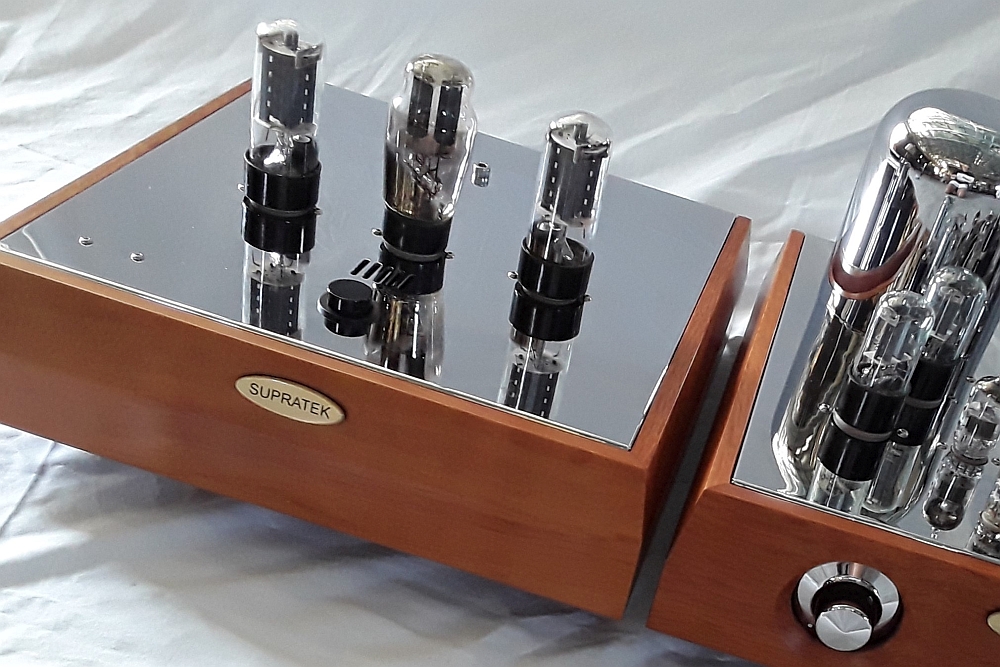
Tuesday, July 3, 2018

Soundstage

Supratek featured in Soundstage:

"What’s more, in the first instance, I’m excited in having provided a widely-read Australian platform to local distributors and retailers. Secondly, I have a deep satisfaction in SoundStage! Australia showcasing to the world, via news items and reviews, the genius behind gifted Australian designers like Axis Loudspeakers’ John Reilly, Brigadiers Audio’s Brad Serhan, DEQX’s Kim Ryrie, Grover Notting’s Frank Hinton, the team at Halcro, Hulgich Audio's Nicolas Hulgich, Legend Acoustics’ Dr Rod Crawford, Les Davis Audio’s Les Davis, M8Audio's Mark Thomsen, Microphase Audio Design’s Jean-Marie Liere, REDGUM Audio’s Lindy Gerber and Ian Robinson, the team at Richter Audio, SGR Audio’s Stuart Ralston, Supratek’s Mick Maloney and last but by no means least, my fellow ‘Wentworth Fallian’, VRC’s Stephen Price. And as far as those many, many other extraordinary audio artisans in this country, though I did not have the opportunity to 'visit' you up to this milestone, be sure that your creations will shine their way to us here at SoundStage! Australia "Before Too Long..." 


Supratek Announces “World-First” LCR Phono Stage

Western Australian valve specialist Supratek, who has been building high-end valve amplification for more than 30 years, has launched a “world-first” LCR phono stage which will be incorporated into the company’s highly revered Cortese preamplifier.
The new LCR phono stage is currently available as an additional built-in stage to the Cortese preamplifier – which is now named LCR Cortese – and will also be available as a standalone unit in the near future. The LCR Cortese employs 6688 and 6H23 valves in the phono stage with 6SN7/6H8C valves adopted in the line stage section while the soon-to-come standalone unit will feature 6688 and 6E6P tubes. The LCR phono stage is only compatible with MC cartridges and has an astonishing 80dB of gain making it, according to Supratek, an LCR circuit world-first.
“Supratek has produced the world’s only moving coil cartridge capable LCR phono stage” Supratek Founder Mick Maloney told SoundStage! Australia, as he continued “All tube phono LCR circuits are rare and expensive, and they are not easy to build, they require very high quality iron chokes and inter-stage transformers. With the Supratek LCR phono stage there’s no need for expensive and restrictive step up transformers. With 80dB of quiet gain the LCR circuit provides new insights into the superior micro-dynamics of vinyl. LCR circuit has amazing levels of texture and body, it really brings out the character and expression of artists and music.”
Supratek
The LCR Cortese’s other specifications are equally as impressive as its extraordinary gain, with a frequency response of 10Hz to 30Khz at -3dB while the overall preamplifier’s gain is adjustable between 0dB and 26dB. Input impedance is a high 100 Kohms while its output impedance is a low 40 ohms, both figures representing excellent compatibility with source and amplification components respectively. The phono stage is suitable for moving coil cartridges of 0.1mv to 2.0mV. Other features of the LCR Cortese are the availability of balanced and unbalanced inputs/outputs, adjustable gain and remote control.
The Supratek LCR Cortese is available direct ex-factory from Supratek.
Australian Distributor: Supratek
+61 437 208 727
www.supratek.com.au
Price: LCR Cortese $US5500

Wednesday, June 6, 2018

Tecnical details LCR Cortese.

The LCR Cortese uses 6688 and 6H23 tubes in its phono stage, and 6SN7/6H8C tubes for the linestage.

The phono only LCR preamp (no linestage) uses 6688, 6688 and 6E6P tubes.

These tubes were designed and built towards the end of the tube era, and are perfect devices for audio preamplifiers.

The LCR Cortese is suitable for any moving coil cartridge, but not moving magnet.
Impedance switching allows for loading of 10,100,1000 and 47,000 ohms (or whatever values are required.

To ensure enough gain with even the lowest voltage MC cartridges (0.1mV) the phono section has nearly 80dB of gain - that's an enormous amount of gain  and its a real task to ensure quiet operation with no hum and hiss below the vinyl floor level.

The input stage of the phono uses a cascode circuit with J-fet and 6688 (E180F) tubes.

With nearly 30 years of development this cascode circuit negates the need for a passive step up transformer and has all the advantages of active operation- greater dynamic range , more linear frequency response and suitability for all MC cartridges.

To ensure it is quiet , a special earthing arrangement is needed, along with extremely quiet power supplies - more on that later.

The next stage (6H23 tube) is another gain stage with transformer output, which provides the low impedance and drive necessary to drive the L coils for the RIAA equalisation.

These are specially built by Lundahl and are finest quality.  They are precisely measured and the required CR values are matched within very fine tolerances.

The last stage (6H23 tube) provides some more gain and the drive needed to couple with the line stage.

Polyprop caps are used throughout, but kept to a minimum.

In line with Supratek design goals, electrolytic capacitors are only used when absolutely necessary - there are only 2 in the phono stage,  and none in the linestage.

Compare this to a typical phono preamp which can have dozens of strident sounding electrolytic caps.

The line-stage is another multi- year development that is designed to be as transparent as possible , in order for the astounding sound of the LCR circuit to come through unaltered and rich in dynamics.
It has extremely low output impedance and will drive any, and multiple power amps.

I've also concentrated on making both the phono and linestage as robust and reliable as they can possibly be.

They only use design circuits and components that will have an almost indefinite lifetime - I'm sure that like other Supratek products it will become a classic that will be performing flawlessly and at the highest level many years from now.

The heart and soul of any audio electronic component is the power supply, and the PSU for the LCR phono preamp is an example of clever and uncompromising engineering focused on sound quality and robustness.

The tube shunt regulated supply for the high voltages is responsible for the Supratek sound- precise imaging and sound-staging , and rock solid stability .

Seperate heater supplies for both phono stage and line-stage ensure super quiet noise levels, even with 80dB of phono gain .

The Supratek LCR phono is the only MC cartridge capable LCR tube preamp in the world.


Monday, June 4, 2018

How did it come to this?

I think this is going to be the most difficult article/blog to write.
I'm preferably a man of few words, and prose does not come easily to me.

But I'm very passionate about sound , and derive enormous satisfaction and pleasure from listening to fine music, so when something comes along that provides even more satisfaction I want to tell all the world about it and provide some clue to what I'm feeling.
I'm not so good at that- but here goes anyway.

How does a tiny pointed rock on the end of a equally tiny piece of metal, swinging between microscopic ridges imprinted into black plastic vinyl provide a sound that is so textured, vivid, and alive with a stereo soundstage that is so wide and dynamic, yet equally seamless with its images of right and left channels.

I have some very good dacs here , I'm up to date in the computer audio world, have a very nice CDP , and am reasonably competent in building and understanding digital.

It doesn't compete in any way in equaling the sound of vinyl playback, in particular the sound of a LCR phono preamp with a high quality moving coil cartridge.

Over the years I've been tempted to sell off my record collection, its bulky, is a pain in the arse whenever I've moved house , and just like digital , not all of the recordings are first rate.

But I never have , because when I take the record out of its cover, place it on the platter, clean it, and then drop that rock into the groove, I'm then always grateful that I never succumbed to the temptation.

LCR phono playback has made me even more grateful- LCR phono is the ultimate playback of any recording system, whether its analouge or digital,  nothing else compares . (Except maybe master tapes)

Its superiority is mostly in dynamics , which is rather perverse as digital has an overall greater dynamic range , but within a LCR phonos dynamic range its faster, cleaner, simply more alive and exciting.

And this force of dynamics is also audible at lower listening levels, if your restricted in the volume levels you can use, the LCR phono is very worthwhile.

In comparison, digital sounds veiled and choked- yes it can sound very good , but the difference between a digital recording and a LCR reproduced recording is night and day.

Digital has its place, it's convenience cannot be denied , and it can sound very good, but for the ultimate listening experience LCR phono , and even very good standard CR phono (both with tubes of course) will let you hear angels.

Its taken me 30 years to build a moving coil LCR tube phono that doesn't require a step up transformer, is quiet and will work with all moving coil cartridges.

In the next article I will go into the technical details of this design.


Moving coil cartridges. Denon DL103, Ortofon SPU, Accuphase AC-3, Dynavector DV30.
All with Expert Stylus cantilvers and diamonds- highly recommended.
The SPU is superb, amazing with tube LCR.


Thursday, May 31, 2018

Multi tube preamp from the archive

This preamp belongs to the guy who makes the wooden cabinets for the Supratek preamp.
Its one of the older 300B designs, about 10 years old now .
I had it back to do a little mod on it, and it still sounds great, especially with the LCR phono design.
The little bit of DHT warmth sounds very nice in the right system.
This 300B design was the early type direct coupled from the 6SN7 driver tube.
Later on I went to a different design that enabled a little more definition , but the direct coupled designs had excellent phase performance which resulted in exemplary imaging.
In truth, even 10 years later the Supratek sound is one of a kind and all of the diferent versions have a very similar sonic signature. Accurate tone and superb soundstaging and imaging.
The beauty of this design is that it could use multiple output tubes- 300B, 45, or PX4.
It had a switch to set different filament voltages and a servo to set the required plate voltage.
Servos can be problematic sometimes, but this one was relatively simple , and has been reliable and problem free over its lifetime, and will continue to be. It ensures that the output tube always sees the correct plate voltage, even as tubes age, etc.

Here's a pix of the stock 300B preamp


and a pix of it with 45 output tubes and vintage 6F8G/VT-99 tubes.


Different sound, slightly more natural sounding,  more open and a bit more dynamic but still highly defined and very 3D like. Very expensive Emmission Lab 45's though, you'd expect a good result.

10 years on, a very capable and excellent sounding preamp, as good as the day it was made.

If you'd like a really nice high end equipment rack, or listening chair or anything in furniture grade wood,  handcrafted by an artisan , contact me and I'll put you in touch with Jon.


Thursday, May 24, 2018

$45,000 for a 12AU7,12AX7 phono preamp.

Flabbergasted, thats what I am.

I just read a review on a just released phono preamp that retails for $US45,000 and it uses 12AU7,12AX7 tubes!!!

12AU7, 12AX7 tubes were designed for use in televisions , but became used in audio as similar replacements for 6SN7 and 6SL7 tubes, which were genuine audio tubes.

The 12 series were cheaper, but nowhere near the quality of the 6 series tubes.

Substitute a 6SN7 for a 12AU7 and the difference is day and night, but for reasons of economy and ease of supply the 12 series tubes caught on and became widely used in the audio industry.

I first used 12AU7 and 12AX7 in a phono circuit about 30 years ago- the popular RCA tubebook circuit.

It used feedback EQ and sounded ok, but couldn't drive a long cable let alone a power amp without the easiest of a load.

I wouldn't even use a 6SN7 and 6SL7 in a phono, although I have built a few phonos to prove it coudn't be done.

Well, actually  it can be done, and again they sound ok, but there were some fantastic tubes released at the end of the tube era which are near perfect for the needs of a phono preamp, and are high gain and have good drive -  these tubes give very high definition , accuracy and transparency.

The 12 series tubes are wimps in comparism and give a bloated ,warm "romantic"and "tube" sound , ok if you like that sort of ting but I guarantee you will soon tire of it.

My LCR and Standard Cortese use 6688 and 6H23 frame grid tubes in the phono section.

The soon to be released phono only LCR preamp uses 6688, 6688, and 6E6P tubes.

These are combined with the fantastic enveloping LCR circuit and state of the art circuit design to produce a circuit you will never tire of listening to and enjoying.

Classic cosmetic appearance, finest sound and $5500 for the LCR Cortese.

Against $45,000 for 30 year old technology ,  and another $10,000 for a SUT so you can use your MC cartridge  - flabbergasting!!!


Saturday, May 12, 2018

Music

A couple of albums I've enjoyed this week- both female artists and both in an acoustic frame, and both at different points in their lives.

KASEY CHAMBERS & THE FIRESIDE DISCIPLES Campfire CD NEW

You never know what your going to get with Casey Chambers, but I'm really enjoying this, some great songs and very good acoustic guitar, uke playing.

Whistle Down The Wind by Joan Baez

Another great album from Joan Baez. You'd never know she was 77 from the singing, but the songs  come from a  voice aged with wisdom and retrospection.

Casey's songs come from someone in the prime of her life, her kids are growing up, she's in a safe place musically, lifes good, although she can sing a blues song with conviction.

Joans seen it all, and is at a stage of life when some things get a bit tiresome , how many times do we have to watch the same old shit - gun control in America , friends dying, being the last leaf on a tree.

Both good albums and recommended - good sound too.

One interesting thing- Casey doesn't have a great high voice, she gets a bit screechy at the higher notes, I think she had some problems with her voice some time back.

One way to soften this is to double track- the producer will put another identical vocal on top of the original, so you get a choir effect that sounds a bit more harmonic and agreeable.

Its very common and just about mandatory for those not blessed with a perfect voice. 
You'll find double tracking, or multi tracking on just about every album you own, but does your preamp enable you to discriminate it immediately ?

Its a sign of a good preamp with excellent definition - you should be able to hear two distinct, separate voices laid on top of each other.

The better the preamp, the better the distinction and the better the harmony will sound.

Monday, May 7, 2018

HighDefinition/High Enjoyment Preamp with LCR phono.


I've been very busy building preamps , so apologies for little blog activity.

This adaption of the Cortese preamplifier is very exciting and achieves some long held aspirations and goals for Supratek.

Firstly, it has an LCR RIAA circuit in it, and put simply, A LCR phono is the ultimate vinyl expression.  I've been building LCR and LR phonos for many years and this design is the result of many circuits tested and evaluated over the years.

LCR has an ease and liquidity which brings real life and vividness into vinyl playback.
In terms of actual objective performance its not much different than the standard Cortese phono stage, but the enjoyment factor is subjectively very obvious , it simply sounds even closer to real music .

LCR has amazing levels of texture and body, it really brings out the character and expression of artists and music- Leonard Cohen sounds more like Leonard Cohen, Dylan like Dylan, classical music surrounds you in sound, LCR really is a big deal, a real significant jump in sound quality.

All tube phono LCR circuits are rare and expensive, and they are not easy to build, they require very high quality iron chokes and interstage transformers.

This Supratek  LCR Cortese is the only tube phono stage in the world that is built solely for moving coil cartridges with output level as low as 0.1mV , and is designed for the majority of MC cartridges.

Why is the Supratek the only MC capable LCR phono, when the other tube LCR phonos are suitable only for MM cartridges. ( and cost up to 6 times more!)

With nearly 80dB of gain needed for low output MC cartridges, its very hard to get tubes quiet enough for MC use, as hiss and hum become audible with such a high gain.

The standard approach is to build a tube LCR phono with 40-60db of gain and use a step up transformer (SUT).

SUT's have limitations in adapting to every cartridge, frequency response and a lack of dynamics.

The active, high gain approach used by the Supratek achieves optimum dynamics and definition from every MC cartridge, reliably and consistently.

Only the Supratek Cortese LCR can achieve these gain levels and remain noise free , essential for the retrieval of micro and macro dynamics from your vinyl records.

A very complex earthing arrangement, over-engineered power supply, (big enough for a tube power amp) and regulated HT voltage , in a seperate matching power supply unit with state of the art componentry and copper chassis's, ensures quiet, efficient operation.

To match the phono stage the LCR Cortese has a line stage that is also especially quiet and capable of  the dynamics of the phono, a well as making all digital and other inputs sound amazingly real.

The line stage is a state of the art tube design, with very low output impedance that can drive any power amplifier, and even a combination of bi or tri-amped amplifiers.

It has the famous Supratek sound, and will carry on the Supratek reputation for reliability and ease of use.

I often hear from customers who have the original preamplifier I built for them 15-20 years ago, with no issues and the same tubes in them!

I've spent a lot of time and effort in ensuring that this preamplifier will perform at the highest level, and reliably over a very long term.

Just as the early Supratek Syrah and Chardonnay preamplifiers became respected "classic" pieces the Cortese LCR will become an item to appreciate and enjoy over a very long time.

With comparable tube LCR phono stages (without linestage) costing well over $20,000 the Cortese LCR is a handsome buy at $US5500.

The Standard Cortese with CR phono stage is $US4500 with 85-90% of the LCR sound quality.

Available in different finishes.


Thursday, April 12, 2018

Realism

More on realism.

Ortofon SPU Moving Coil cartridge. (on Dynavector DV-505 arm)

LCR phono preamps.

R2R dacs with tube output stage.


Monday, April 9, 2018

What is your experience for the most liquidity and presence of midrange and emotion, if not an all DHT tube rectified transformer coupled pre-amp ?

I was asked this question:


What is your experience for the most liquidity and presence of midrange and emotion, if not an all DHT tube rectified transformer coupled pre-amp ? 

This is a very complex question with a myriad of complex answers, but is very interesting so lets dive in .

I think the key word here is EMOTION, ie the feeling we get that we're connected to the music and the musicians and participating in the joy of the performance. 

Its quite different from the "hi-fi" experience which often becomes quite critical and even non-satisfactory sometimes.

To achieve this emotion does take a very good preamp, which I will go into, but primarily it means a synergy of the whole system , which must be very carefully tuned to be above all things REALISTIC.

To get emotion, we must be coerced into thinking we are listening to an actual performance , voices must sound real and personal, our system has to fool us into thinking we are listening to the real thing, or as close as possible.

That doesn't necessarily mean accuracy, although its important. Our perceptions and listening equipment - ears, consciousness are not the same and are not linear, if you have ever seen Fletcher-Munson curves you will see that it makes a mockery of linear flat response 20Hz-20Khz, although it is important to have a standard. 

More important than linear frequency response , I think , is dynamics, especially micro-dynamics.  This is the source of realism , this is what makes recorded music sound real, when you can hear the whole spectrum.

But don't confuse this with detail, as many do, detail is often just a tilt of the frequency response to brighten the top end , and eventually becomes tiring and un-realistic.

Dynamics are essential, and it is essential that every part of the system can reproduce it, but it will all fail if the final component in the chain- the speaker isn't capable of doing micro and macro dynamics.

I have 4 speaker systems in my factory, they all have strengths and weakness's and I wouldn't call any one of them the "best" - I like all of them and enjoy them all.

There is one speaker though that repeatedly stuns people with its realism and portrayal of "emotion".

Its a high efficiency, (nearly) full range Supravox driver , with field coil magnet, that is used in an open baffle with 15" open baffle bass drivers above and below it , and a RAAL tweeter . Simple 6dB passive crossovers , but a DEQX digital crossover for low bass crossover and some bass room correction. 

Seperate tube amps for the Supravox and RAAL, and a SS amp for bass. 

The Supravox has dynamics that are astounding . Its not perfectly accurate, but with active operation can be adjusted to be reasonably accurate.

But for realism and "you are there",  high efficiency speakers have a real advantage in achieving the dynamic range that is needed, to fool one into thinking "they are there".

Unfortunately, there are many more flawed HE speakers than there are good ones. Some are used full range and have terrible frequency responses that emphasise a particular part of the response and become very tiring to listen to. 

People then use "soft" or "warm" SE amps to correct this situation, although it rarely does. 

Horns are very efficient, and there are some very good horn systems, although its nearly impossible to remove the coloration of the horn geometry. But the dynamics are there in spades , and for a sense of realism they are remarkable, depending on the level of coloration - some are exceptionally good, many are bad.

Dynamics can be achieved with more conventional moving coil speakers, but it usually means multiple drivers and very powerful amplifiers. 
Multiple drivers means multiple crossovers, usually in the worst frequency ranges, and complexity harms dynamics. 

Not to say that these systems can't sound very good, they certainly can, but its not easy or inexpensive to build them.

However we do it, we need full scale dynamics from our systems for realism.

We won't get it with "warmth" or "romantics" or tilted frequency responses .

No lets get back to the original question:

What is your experience for the most liquidity and presence of midrange and emotion, if not an all DHT tube rectified transformer coupled pre-amp ? 

What does liquidity and presence mean ?  The hifi reviewers will come up with all sorts of lovely words, but for me, realism is just fine.

Not warmth , or musical, or syrupy, or all the other descriptions that really describe a lack of dynamics . 

There are plenty of old style tube preamps around that sound like this , simply because they don't do dynamics well. 

For example , low gain triode stages AC or DC coupled to a cathode follower buffer, no dynamics and boring as hell. 

To achieve startling dynamics a tube preamp must have gain , and the more gain, the more dynamic it becomes, up to a point of course, but in virtually every situation, a high gain preamp will sound more realistic.

When I made the first commercially available 300B preamp, it had a 6SN7 triode as a driver tube, to get the gain it needed to be dynamic. Without the 6SN7 it was just another "nice" sounding  preamp. 

All the DHT preamps I built using 300B, 45, PX4, 101D ,4P1L etc had a 6SN7 driver stage to get the gain needed for a dynamic sound with a wide soundstage and precise imaging. 

They also were used with output transformers to limit the gain to manageable levels and provide low output impedance and powerful drive ability.  6 solid state power amps in an active system? No problem!

DHT tubes aren't perfect though, and when combined with high gain designs can be problematic in regards to microphonics and noise. 

And although DHT designs can produce perfect frequency response and square waves, I do feel that some dynamics is lost through the direct heater connection of a DHT tube.

So to turn the question around to: 

What is your experience for the most REALISM , if not an all DHT tube rectified transformer coupled pre-amp ? 

I would say my choice would now be a high gain non-dht 6SN7 design with transformer coupling , or perhaps a 6SN7 driver with a 6N6/6H30 White Follower.

If you have an different interpretation of "liquidity and presence of midrange and emotion" and think it should mean warmth or some other form of coloration then yes , a DHT preamp should suit you fine, at the expense of  some micro-dynamics. 

Again, it all comes down to the synergy of the entire system, perhaps with a bright HE speaker, a DHT preamp would be the best solution , or if "warmth or romantics" is something you value then again a DHT preamp should suit.

There's really no right or wrong, its a journey to find whatever ultimately helps you enjoy the music. 

After 30 years of building preamps and using just about every available triode tube, for me the 6SN7 and its equivalents are still "king" of the preamp tubes.  
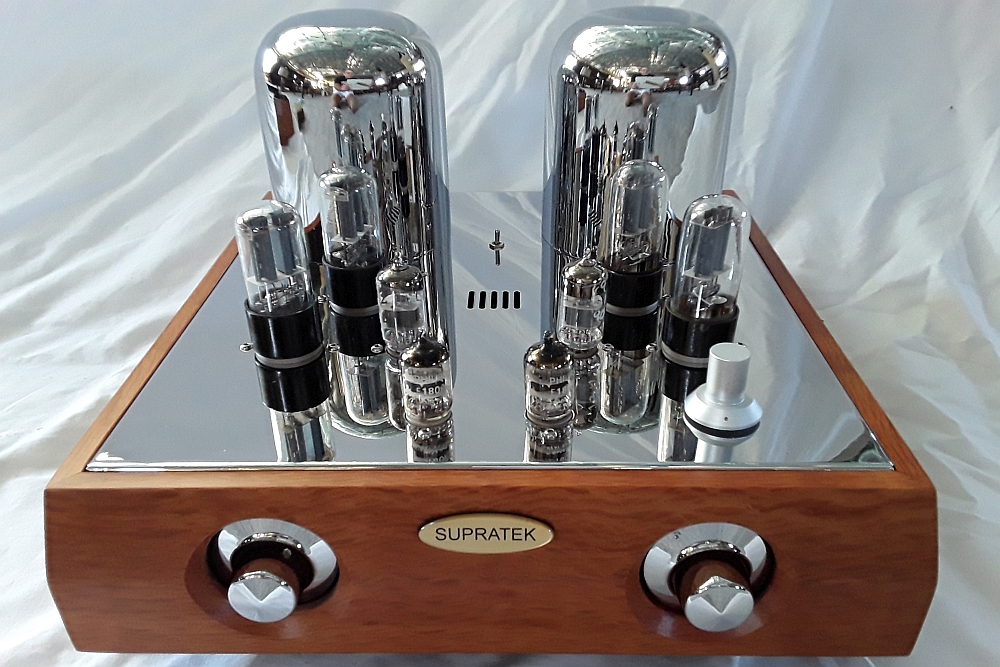


Monday, March 26, 2018

Were back!!!!

Yes I've been away from the blog for a while, I've been developing some new products and I kind of get tunnel vision when I'm doing that , and devote most of my time to it.
Some exciting new phono designs coming out soon, and a big development for the line stage.

I'm the first to admit my products are designed to be first and foremost of the highest quality sound, with practical considerations still important but not at the expense of sound.

The Suprateks have always been high gain preamps, mostly for the dynamic performance it brings, and it works a treat, as an example, the last few preamps I've built for customers brought comments like -"astonishing sound"  and "incredible soundstage"  but one of these customers has a very high gain power amp and combined with a high gain preamp it resulted in some hum and noise.

Which is why high gain tube preamps are rare- its very hard to get them quite enough when used with high gain power amps.

Low to medium gain power amps are fine- there will be no audible noise with them, but sadly there are too many power amps with high gain these days, which really makes them integrated amps with a built in second rate preamp.

So in fact your putting a preamp in front of another preamp, which isn't necessarily a bad thing, but real audio excellence comes from a high gain preamp providing voltage, and a low gain power amp converting that voltage into current, to drive the speaker.

But it isnt a perfect world, and high gain power amps do exist , and if people must use them, then a Supratek preamp isn't ideal.

Of course I have been conscious of this for a long time, and for a long time I've been trying to build a lower gain preamp with the same sound quality of the higher gain , but I've always felt that the many prototypes I've built "de-tuned" the sound. It always felt liking I was replacing a V12 Ferrari with a V8 Ferrari, still very good but not quite in the same class.

I'm happy to say I've finally found a circuit that has lower gain with all the dynamics of a high gain preamp,  and may actually sound even better!

It works with all power amps, tube or solid state, high or low gain.

It's also a little less complex and will be even more reliable than the older designs, most of which are still performing 25 years later!

This design is now the default Supratek preamp line stage and is in production.

Tomorrow how to build a (very) cheap digital server, that sounds pretty good.


Wednesday, January 31, 2018

From My Stash

I've built so many preamps and power amps over the years , but some have been my favourites as they suited my taste, system I was using then and curiosity for technical prowess at the time.

I've kept some of them and will do a story on one or two over time.

I was reminded of this one when I did the article on impedance matching and put up a graph of a SE amp driving a simulated speaker load.

It showed that SE amps dont have low enough output impedance for linear response and the resultant coloured response.

If the output impedance of the amp can be lowered the result will be better, and the way to get low output impedance is to use a low plate resistance tube.

 The Russian 6C33C-B tube is one of the lowest Rp tubes available and with a good transformer can give quite good results with a broader range of speakers.

I built quite a few of the MERLOT amps with the 6C33C-B tube with 6SN7 input tube and 300B driving the 6C33C-B .

                                                              Merlot amps at front

The best ones used Plitron output transformers and they were awesome amps, unfortunately you cant get this transformer any more , mores the pity.

This amp I built for myself  about 10 years ago- it has Sowter transformers , and uses 6SN7 driving 300B , driving the 6C33C-B tubes.  The other tubes are a rectifier tube and a 6AS7G used as regulator for the power supply.

Monoblocks , so two for stereo.

Very nice amp , puts out a solid 18 watts and can drive most speakers .

It can be configured as cathode follower , which lowers the output impedance even more, but the consequent feedback generated does take some of the sweetness from it.

Its sitting in my collection , and unused for a few years now, but will be used again when I get a horn system going again.


Friday, January 26, 2018

LCR Phonos

L(Inductance)C(Capacitance)R(resistive) phonos have been around for a long time.

They are simply a different method of getting the EQ required in a phono preamp to change the signal from a record into flat frequency response.
Instead of using C&R , as is usually used an inductor L is added.

Tango, the famous Japanese transformer company, made a unit that had multiple inductors plus the necessary caps and resistors in it, quite a few years ago .
It was the inspiration for many diy LCR phono stages but rarely available commercially as they are expensive and tricky to implement .

Tango Circuit

I built quite a few LCR's 15 years ago but always found them a little inaccurate  and prone to hum, with the inductors picking up any stray AC fields.
A good tube CR phono can also sound very good so why make it harder.

In conjunction with Kevin Covi I also built a lot of LR phono prototypes, which I think is a better approach, as this eliminates the C , which is mostly a good thing.
These are tricky though, just a slightly wrong value of L or R and frequency deviations are more than what is tolerable.

And building an active tube phono that can give enough gain for a 0.2mV moving coil cartridge is tricky enough without complicating it with noisy inductors.

Which is why commercial LCR phonos released over the last few years are for MM cartridges only or require a step up for MC cartridges.

Michael Fremer , the influential analogue reviewer has a LCR phono in his system, and his acclaim
of its sound has introduced LCR phonos into the audiophile mainstream.

The unit he uses is very expensive, and is confined to MM use or MC with an overly expensive step up.

Its a very nice design and very well made, but I have no love for step ups , and I decided to re-investigate the LCR approach.

Fortunately , all the ground work was done years ago , and our hybrid LCR phono , using CR and LCR stages , with a few innovations and Lundahl inductors works and sounds perfectly.
And it is capable of gain for the lowest output MC cartridges, with no step up,  so dynamics - micro and macro are stunning.

As Fremer says, a good tube LCR phono doesn't sound "tubey" , their forte is revealing micro-dynamics . I dont think CR tube phonos are shamed by them, but there is something inherently nice about them.

Now I need to go back and do some work on a LR phono , which could be even better again!


Tuesday, January 23, 2018

Listening levels

I had a request to do a blog about listening levels and how they relate to speaker types and efficiency.

Fortunately I have a listening room that's quite isolated and I dont have to worry about how loud I listen to music.

And I do prefer listening at slightly elevated levels rather than at background levels, its just a bit more involving and interesting.

However, many are constrained by having to share their stereo system with family, neighbours etc and turning the wick up isn't always possible.

So what are the best speakers for listening at lower levels and obtaining the maximum resolution , detail and enjoyment?

I suppose 80% of speakers are moving coil box speakers with efficiency around 80-90dB.

Typical of this design are my Lipinski studio monitors.

When I finish a preamp build I always test them on the Lipinskis, primarily because they are very accurate , and because they closely resemble what 80% of my customers will be using themselves.

The Lipinskis will quickly tell me if a preamp is operating at 100% quality ; its a very capable tool that is also very engaging and nice to listen to.


But its not so good at low listening levels , which is typical for all medium efficiency box speakers.

They sound a little "veiled" , hindered in dynamics and detail.

Higher efficiency speakers however have an ease , a directness that does make them more listenable at lower levels.

Not always the most accurate of speakers, which is perhaps a compromise they make for dynamics , but always interesting.

My Supravox field coil drivers are up in the high 90's for dB and while I wouldn't call them the most accurate drivers they certainly are fun to listen to, at any level.

Horns are of course the highest efficiency speakers and dynamics are unriviled , the softest sounds come through loud and clear, although they can be coloured and take up room, and perhaps not the prettiest speakers. I've always had a pair of horns, and although I dont have these anymore I have another pair waiting to be configured.


Similarly,big panel speakers which have a driver surface area many times higher than a box driver , can throw a much larger soundstage even at lower sound levels.

Some of the really low efficiency panel speakers are exceptions as they struggle to use power, but get a good medium efficiency panel and you are enveloped in sound.

My Acoustat 2+2 are each 8 feet tall and 2-1/2 Feet wide - with high power amps they fill the room with a vast soundstage and are just as exciting at low sound levels.

What to do if you are confined to box speakers and lowish listening levels?

A good dynamic pre, usually with high gain,will help greatly, the more dynamics you can get the better and a good pre with a highish power solid state or tube power amp will sound alive and interesting.

Any topics you would like covered ? Email me at supraATsupratek.com.au

But please no gurus who want to argue, these posts are intended for the average audiophile and are deliberately  basic in  concept.


Thursday, January 18, 2018

Impedance matching

Impedance matching between different devices can be confusing, so here is a very simplified analogy.

A loaded truck driving up a mountain has to downshift gears to enable the engines torque(power) to be used.

Its  a difficult task (load) and more driving power is needed.

Once the truck gets over the hill and is coasting down the hill very little power is needed as the load is lightened by gravity.

With a preamp, power is related to low output impedance , but its relative to the load (power amp) it has to drive.

If a power amp has an input impedance of 10,000 ohms, then an ideal ratio of 10:1 would mean a preamp impedance of 1000 ohms.

10,000 ohms is a typical figure for a solid state amp, but a typical figure for a tube power amp is 100,000 ohms, so applying the 10:1 ratio the preamp could have an output impedance of 10,000 ohms.

10:1 is like the ideal gearing in our truck analogy, the power can be transmitted cleanly and without strain.

There's no loss of gain and frequency remains linear .

Its possible to get the output impedance of a tube preamp down to 100 ohms or less, which would drive the most difficult solid state preamp, but there can be sonic compromises to this .

An output impedance of around 1000 ohms is ideal for a tube preamp, as it can be feedback free and still capable of driving 95% of solid state power amps.

Things get a bit more complicated when we look at the impedance issue with power amps driving loudspeakers.

If a speaker has an impedance of 8 ohms then applying the 10:1 rule we need a power amp with impedance of 0.8 ohms.

No problem for a solid state power amp, but a tube power amp which, without feedback , will have a higher output impedance will not be able to achieve this ratio.

The problem is compounded in that a loudspeaker doesn't have a constant impedance - it varies with frequency and can shift from less than an ohm to a 100 ohms, which is worse case, but they all have varying impedances.

Use a Single Ended , no feedback,  tube amp which will have a high output impedance and the resulting frequency response will be far from linear.

Which is why many people like Single Ended amps, they act more like a tone control, accentuating the mid range and sounding "romantic" .

Single Ended amps are best with easy loads, like crossover less full range drivers, or used in bi/tri amp systems, driving the midrange or treble drivers.

Push Pull tube amps, with a little feedback,are much more capable, but still need a loudspeaker suited to their capabilities.

Fortunately the preamp/poweramp impedance issue is a lot more straight-forward , and you really can't get better sound than combining a capable tube preamp with a tube or solid state power amp.


Here's a measurement of a single ended tube power amp with output impedance of around 2 ohms - the black line is frequency response into a simulated speaker. Its actually not too bad for a SE amp, but it's far from linear, and will sound coloured.


Saturday, January 13, 2018

Vinyl phono stages.

The Supratek phono stages are designed for moving coil cartridges only.

Why no provision for moving magnet?

Well I'm sorry but if you are going to spend considerable money on a phono preamp then you may as well buy a quality cartridge, and in my experience moving coil cartridge always gives a better result.
Yes there are some good MM's but even a good quality budget MC will always sound better.

Its my opinion, and some will disagree, but I build the preamps to what I consider the highest standard ,  so MC it is.

In some ways I'm making it harder for myself- as I've pointed out MC have tiny voltages and need enormous gain , and to achieve that gain with tubes, and no feedback is difficult.

There's two ways to get the extra required gain for MC compared to MM. Passive and Active.

Passive is a step up transformer , and its the method most manufacturers of phono stages use.

They are quiet, reliable , and I'm a big fan of transformers in audio, but not for phono stage inputs, phono step ups always sound limited in dynamics and "choked" to me, they just bore me , its as though someone turned the excitement down.

Actives use electronic methods to get the gain, either more tubes (too noisy) or with FET transistors in front of the first tube.

They are very dynamic sounding and handle the tiny voltages perfectly, I dont think there is any comparism in sound quality, and its not a small difference, active is alive and exciting.

So why are most tube phonos designed to use passive step-ups?

Tubes are wonderfully linear devices that dont require feedback to give very accurate preformance, but they are not as quiet as solid state devices , or passive transformers - they have a noise floor that is louder than solid state or passives and when you amplify thousands of times the noise floor can become  audible as hum or hiss.

So you cant simply add more tube stages to get the required gain as noise will become a problem.

If one is determined to use an active method, for the most realistic sound ,then fet's are the ideal solution, these little guys work more like a miniature tube than a transistor and are quiet.

In combination with very quiet and substantial power supplies, very well designed and implemented grounds and good circuit layout, the gain for low output moving coil cartridges with outputs of 0.2mV can be realized .

Its not easy, which is why very few manufacturers even attempt it, but the noise can be down below the noise floor of a vinyl record, which is all that is required.

Still not as quiet as a passive , its true, but the combination of a low output MC cartridge and an active tube phono stage easily surpasses any passive method, even the ultra expensive passive phono devices struggle to come close to the excitement of active vinyl.

Tomorrow, LCR and LR phonostages.


Thursday, January 11, 2018

Recording Quality

Is DSD audibly superior to MP3?

Yes of course it is, provided the recording process and equipment is of equal quality.

I have MP3's in my hard drives that sound quite wonderful, because the recording equipment and process , the mastering etc were first class.

I also have DSD recordings that are terrible, because they were made from a bad recording.

Sound quality is determined primarily by the recording quality- you cant turn a poor recording into a good one by increasing the bit rate or converting mp3 into flac or dsd.

Years ago I built a tube based microphone preamp for a pair of ribbon microphones, which are consider to be the most "analogue" sounding by musicians- they like the sound compared to cardoid , omnis etc.

We taped a small guitar/banjo combo at a local pub , ribbon mics straight into the tube preamp , then into a reel to reel tape deck.

Minimal mastering and then converted to CD. The recording was exceptional , did a really good job of recreating the performance.

Unfortunately someone brought a little kid who cried all the way through, and it came through just as well!


Tube Microphone Preamp. 6SJ7/ECC88 tubes. Balanced/Unbalanced in and out.
Has matching regulated power supply.
Ribbon mics.
Would consider selling this, makes very nice class A recordings.


Tuesday, January 9, 2018

Vinyl


What they say about vinyl being more tangible , of more substance, relates not only to the musical quality.

Back in the day, buying a new vinyl record meant more than just the presentation of a new recording.
It was something that you held in your hands, something that was a source of interest, of information, and stimulation, more than just the pretty woman on the cover.

Playing a vinyl record involved unpacking, placing it on turntable and placing cartridge needle in the groove, and in 20 minutes you did it all over again.

The 60's, 70's and 80's were also when music broke fresh ground, the time was ripe for a brand new sound , and a plethora of songwriters and musicians wrote groundbreaking new forms of music and song. Its no coincidence the golden age of songwriting happened along with the golden age of vinyl.

I've been listening to vinyl for nearly 50 years now - these days its not my main source of music.
I listen to music while I'm working and its simply easier to turn the computer on and listen to a whole album or leave the music on shuffle.

And its true that digital audio is very good these days, there's still a lot of bad digital around, but when its good its very good.

I actually believe good digital is more accurate than vinyl, and with a good recording, which is the actual quality determining factor of any source, digital can be closer to the recording than vinyl.

Vinyl has a lot of potential for coloration,  mostly on playback in our systems , whereas digital software and hardware is very constant and uniform.

BUT, there is something about vinyl, its totally immersive , and its seems to be far easier to sink into the music listening to vinyl than digital.

Vinyl washes over you, it makes you forget what you were doing, and the 20 minutes goes far quicker than you thought.

Being a tube guy, I naturally think the only way to listen to vinyl is through a tube preamp, with a tube phono stage.

There's good technical reasons for this , vinyl playback through a cartridge tip is feedback free, its a perfectly physical process , that converts magnetic movement into electrical signals.

The resulting frequency response is far from linear , and massive amounts of EQ are needed to get it back to flat.

Combine this with the fact that the signal from the cartridge will be as low as half of a thousandth of a volt for a moving coil cartridge and 5 thousandths of a volt for moving magnet.

To get it up to typical line stage input levels we need to amplify it by at least 5000 times, not an easy task.

Well it is an easier task if you use lots of feedback , which simplifies a lot of problems.

Feedback can be very useful, and it can be the devil, the amount of feedback that is typically used in a solid state phono stage chokes all the life and soul out of vinyl playback.

Its very hard to build a solid state phono stage without a lot of feedback , it can be done, but the royalty of phono stages is the zero feedback tube phono stage.

There are compromises , when you are using tubes for gains of between 5000 and 10000 you are also amplifying the noise floor,  so its hard to get a tube phono stage dead quiet.

However it is possible to get them quieter than the noise floor of a vinyl record , so its really not a big issue.

The massive EQ required of a phono stage is always almost done with large amounts of negative feedback with solid state devices , but can be done with zero feedback with tubes.

Feedback with vinyl is bad m'k , something so expressive and free, just doesn't deserve to be castrated and chained.

Vinyl can be beautiful, impressive, strong, expansive and simply great fun.

A good bottle of red or a fine craft beer, give me vinyl!

In other blogs I will explain virtues and compromises of the 300+ tube phono circuits I have designed and built (in conjunction with Kevin Covi)


                                 One of my turntables , the mighty Micro Seiki RX-5000


Sunday, January 7, 2018

Exotic components-2

Bob pointed out I didn't mention volume controls.

Its the obvious DIY approach for many as its relatively easy to do (and also pretty easy to get wrong)

There's ladder resistor pots, and variations on them, transformer volume controls, autotransformer controls, electronic stepper pots.

Some of them can sound good, some of them are more properly called tone controls , and some are terrible.

I tried to get along with some of the more exotic VTC, ATC's  but long term they are nothing but trouble.

Like exotic caps, they just sound different, not necesarily better . Its very important to use the right values of pot in a preamp circuit, as just putting anything in can cause serious frequency inaccuracies. 

Like wise, impedance matching is critical when using VTC, ATC's.

In my opinion, the best pot is what's been the standard for a very long time- the carbon resistive pot.

I use high quality Alps pots in my preamps, but to be truthful even a cheap carbon pot will always sound pretty good, and I doubt anyone could hear the difference in a double blind test.

The Alps have better channel to channel specs, but its minimal, and any good preamp will have a balance control to enable pin point imaging and sound-staging.

The old faithful carbon pot is transparent, accurate and reliable.

And they can be easily configured for remote operation, which just makes relaxing and listening to good music more enjoyable and fun.

Nothing worse than having shuffle on and the next track 3dB louder than the last, at least with a remote volume its nothing to adjust from listening position.


                                                        Alps Blue Pot, motorized.


Friday, January 5, 2018

Exotic Components

Another contentious issue perhaps.

You can spend a lot of money on exotic capacitors, resistors, switches etc.
Gold/Silver paper in oil capacitor?
Pure Silver wound transformer?
How much money do you have sir?

I recently had a preamp returned for a modification upgrade.

It had been filled with expensive capacitors , silver plated switches and ridiculous amount of cap bypassing, along with some questionable soldering skills.

Unfortunately the "technician" who did the work had also made the preamp un-operational and it was returned to me for a repair and upgrade to latest circuit.

Over the years I've tried lots of premium parts in my preamps, and there is definitely a place for the best quality possible, some components are very critical - transformers for example, and my distaste for electrolytic capacitors doesnt have to be repeated again- Supratek preamps have about half a dozen electros at most while most preamps have hundreds of the nasty devices.

For signal capacitors I use polypropylene film or good quality paper in oil caps, yes there is a difference in quality between a cheap and nasty polyprop , but once you get to a certain level of quality , differences become just differences, not significant steps in quality.

                                           Just some of the caps tested over the years.

And these differences are quite minimal, mostly inaudible, although the cost of some of these items requires the brain to justify some audible "improvement".

I left the expensive caps in the preamp when I rebuilt it, at the customers request, but on listening to it I had to take one expensive pair out, as they were just horrible sounding.

This preamp did sound different, albeit it was minor, compared to the stock preamp built with my choice of high quality, but non exotic components.

It certainly wasn't "better" in terms of sound quality, it had a slightly different tone, very minor, but probably enough for a zealot to proclaim as significant.

The fact is changing the current running through a tube, like the 6SN7 for example, from 4 to 8 milliamps will make an audible difference, changing the operating voltages, or the type of plate loading  will make a difference, as will an output transformer designed and optimised for the application.

Most of the time these changes can be measured (not all the time) - the role of the circuit design is paramount to sound quality, not the level of exotic components.

Good circuit design, over engineered and high quality components ( not necessarily overly  expensive) are far more important than filling a chassis with so called exotica which has profit for the vendor as its main purpose.

As an aside, I do like a Russian military teflon paper in oil cap I use in my preamps as it seems to have a nice synergy with the circuit and other poly caps in preamp.

Its not cheap, but a fraction of the cost of an exotic Teflon capacitor that frankly sounds brittle and nasty.


Thursday, January 4, 2018

Music

This hobby/passion is all about music, so occasionally I will post some music I'm enjoying
.
I've liked Bruce Cockburn for years, although some of his work can be a bit "different".
I really like this one, not bad for an old geeezer 72yo.

Bruce Cockburn - Bone On Bone (2017) {True North Records TND678}

It's been six years since Bruce Cockburn delivered a studio offering. His daughter was born in 2012, he assembled a career-spanning box set, and wrote a candid memoir, Rumours of Glory. When he was finally free of his writing and curatorial chores, he wondered if there was anything left to say. A book of poems by Canada's greatest 20th century poet, Al Purdy, provided inspiration. The song "3 Al Purdys," in which Cockburn sings and speaks the yarn of a homeless wanderer under the spell of the poet (and weds his words to Purdy's) is one of the finest tracks here (and one of four to feature jazz cornetist Ron Miles). Cockburn's less concerned with perfection, particularly when it comes to his vocals. In his seventies, his instrument is gruffer, but via Colin Linden's immediate production, it proves a benefit. "States I'm In" is a searing, insightful, rearview look at what Cockburn's witnessed – beautiful and horrible – in his global travels as a musician and an Amnesty International observer.

He transforms the song from reverie to a meditation on the present realities and in his own life and society. There's a more overt engagement with Christianity on this record, balanced by a sense of "growing tenser with the times" while living in a country led by Donald Trump. The bumping rockabilly shuffle "Stab at Mater" (a wonderful wordplay on the Latin "Stabat Mater") illustrates the experiential grind between spiritual insight and everyday life that deepens them both. Members of his local San Francisco church were recruited as a chorus here and elsewhere, including on the folk-inflected, poetic, yet urgent "Forty Years in the Wilderness." ("…getting to the know the beasts….") "Looking & Waiting" is wafting acoustic reggae. Buoyed by the chorus, it's a hymn to knowing full well that waiting is indeed the hardest part of faith. The title track is a gorgeous instrumental acoustic guitar workout, while "Mon Chemin" is a jazzy, Latinized folk song buoyed by charango and dulcimer, with Miles' cornet, accordionist nephew John Aaron Cockburn, bassist John Dymond, and drummer Gary Craig. The final two tracks also use blues as jumping-off points. On "Jesus Train," Cockburn delivers them through fingerpopping, house-rocking 21st century gospel. It's followed by the traditional "Twelve Gates to the City" (so closely associated with the Rev. Gary Davis). Cockburn makes it his own by adding some new lyrics and a radical NOLA-styled R&B arrangement – Miles' Louis Armstrong-esque fills and the chorus add soulful weight to the proposition. Bone on Bone is a fine, deep return. This somewhat grimier and edgier Cockburn is clearly inspired, his lyrics are both jagged and elegant; they dovetail in songs that question and reveal the rough-hewn beauty of a life guided by spiritual principles. He continues to question these principles while affirming their primacy as a witness to the world's brutality. They also struggle with the next right thing and how to accomplish it, even when it seems pointless to try, and that kind of struggle is the kind of hope we need more of.


Eilen Jewell - Boundary County (2005) {BMI}

Eilen Jewell's country-blues flavored folk on Boundary County will remind listeners of many new, talented women singer/songwriters without ever seeming like a copy. Like Jolie Holland, she slurs her muffled vocals on a series of original songs and accomplishes the neat trick of evoking tradition. Like the Be Good Tanyas, Jewell relies on fairly eclectic arrangements, though she's more progressive in her marriage of electric and acoustic elements. The slow, sad "So Long Blues" ventures toward pure country with Jerry Miller's lap steel underpinning Jewell's lonesome vocal, while the spunky "Gotta Get Right" captures a more folksy feel with banjo and mandolin.

On both, Johnny Sciascia's upright bass is heavy in the mix and sounds more like an electric bass. Jewell is also frequently joined on the choruses by drummer Jason Beek's deeper, raspier voice, an intriguing combination in which both voices intertwine while keeping their identities. A couple of the songs – "The Flood" and "Blow It All Away" – seem a bit long, and it's easy, especially with the latter, to allow Jewell's lazy, bluesy vocal to fade into the background. These tracks, along with the two that follow and bring the album to a close, lack the vim and vigor of the album's earlier tracks. The first two-thirds of Jewell's Boundary County, however, is well-written, well-sung, and well performed, and will please fans progressive traditional-flavored music.


Wednesday, January 3, 2018

Balanced V Unbalanced

Ok this is going to upset a few people.

I don't like balanced operation and only use it when I have to.

I do supply balanced inputs and outputs on some of my preamps, but only because people want them, and because sometimes you have no choice.

Balanced operation comes from the pro-audio world, music venues etc, and is used to cancel out noise that is caused by very long cables, and less than ideal electronic applications.

It doesn't cancel all the noise but does a pretty good job of making it inaudible.

But balanced operation doesn't do a better job than a properly designed and implemented unbalanced design in normal hi fi home situation, if you are using 200 metre long cables you need another house!

Balanced operation in hi fi situations is a clever marketing ploy based on fashion.

Below is a simplified circuit of a cascaded tube preamp.

The round circles are tubes, the squiggly lines are resistors and the parallel lines are capacitors.

It's very simple and very effective, has nice harmonics , good phase response, all you need really.

If it has a good power supply, is designed and constructed properly it will be very quiet with very little, if any, hum and noise.


Below is the same circuit in balanced mode.

Note how there are double the components , two different phases and operating in differential or push pull operation.

It wont be audibly quieter than the above unbalanced circuit, unless you want to drive 200 metre long cables. Harmonics aren't as nice as single ended and there's no guarantee it will be perfectly balanced between tubes and components.


After many years of building both balanced and unbalanced preamps, I've still to hear a balanced circuit sound better than a simpler unbalanced circuit.

To my ears there's always a slight veiling, a lack of cohesion and clarity with balanced operation.

Yes there are plenty of good sounding balanced power amps , but I've never heard a  good balanced preamp.

The perfect place to use a balanced circuit would appear to be with moving coil phono cartridges. The voltages from MC cartridges are minuscule , around 0.5 mV , that's half of a thousandth of 1V!

Using tubes to get the required gain of 5000 is tricky , as the noise floor is also amplified, so balanced operation makes sense in this situation.

I built hundreds of differential balanced phono-stages and never heard one that sounded as good as a really well built single ended phono stage.

Yes they are quieter but a well built single ended phono will be quieter than the noise floor of a vinyl record anyway, so there's really no point.

Below is how Supratek preamps provide balanced operation.

The Single ended circuit remains but I use transformers to accept the balanced input and provide balanced outputs.

Good quality transformers, brands like Lundahl , Jensen and Magnequest provide perfect phase splitting and combining- without any of the complications of a doubled-up balanced circuit.

Nice even harmonics are maintained throughout the circuit , and it can be easily switched for balanced or non balanced operation.

Its a win-win, gives true balanced output, there's no price to pay, no compromises and sounds as good as balanced gets.


Tuesday, January 2, 2018

New Year New Models

Happy new year to everyone. Sorry for lack of blogs lately, I had some commitments I had to take care of, but all done now and from Jan 2nd I can devote all my time and effort towards Supratek.

I'll try to do a blog every day, and should be able to find some  interesting audio topic each day.

Also this year I'll be bringing out some new models, an entry level preamp and a stand alone phono stage.

Also will finish off Bob's field coil PSU!

Tomorrow I will do an article on balanced v unbalanced operation and why I generally don't like balanced .  It will be a bit contentious, so have a read and decide for yourselves.

Here's a pix of what I got up to over the holiday period, the most fun you can have with clothes on (as they say)


Sunday, December 10, 2017

Passive/Active

I see a lot of guys going through rounds of speakers, amps, preamps, dacs in the quest for the perfect sound. Or at least the sound they could finally be happy with.

But the sound they wanted could have been in front of them all the time.

The fact is, there is no perfect sound, we all hear, and seek different audio nirvana.

What I consider important to sound quality, you may dismiss in favour of some other aspect, and that is perfectly correct, audio is personally subjective.

There are many ways to voice a loudspeaker, from monitor quality, accurate frequency speakers for studio use to romanticly flavored midrange accentuated ear pleasers.

But no speaker will sound exactly as the designer intended in every room, or system.

There are so many variables that affect the sound,  that a speaker can sound vastly different from room to room,  and system to system.

One way to get closer to the sound that suits you is to actively drive the speakers individual drivers , thus providing some adjustment to tonal balance, with other important advantages.

I'll describe a couple of my own passive/active systems to explain.

Btw passive /active means the original passive crossovers are retained but split so they can be driven by a set of amps. So a two way speaker would have 4 amplifier channels, and a 3 way would have 6 channels.

Fully active means no passive crossover and crossover done by electronics, either digital or analogue.  This can give even more control over the sound, at some compromise.

I have an old set of AR-LST speakers , a legendary speakier that has a reputation for excellent sound, but difficult to drive and match to an amplifier.
It is a 3 way speaker, but with 9 drivers per speaker, and a rather complicated crossover.
In stock form it needs a very capable amp with lots of power , yet high quality as it is very revealing.
I could never get it to sound quite like I wanted, so decided to run it actively, to see if  I could manipulate the sound into shape.
I had to modify the crossover so that an amplifier could be connected to each of the bass, midrange and treble sections.

While I was there I replaced some of the older electrolytic caps for more reliable and accurate polyprop caps.

3 sets of amplifier connectors, split crossover sections.


Now that the load to each amp was now only a single section rather than the complete crossover,  it is much easier to drive, and I can even use low power tube amps for the mid and treble sections,  giving a much nicer and realistic sound.

But the real advantage is that now I can adjust the levels of each amp and the balance of the overall tone of the speaker.
It takes some time, and persistence, but there will come a result of each amps level adjustment that will result in the perfect combination of room and speaker , and your own taste, that will be very pleasing.

You will find that there is much more distinction between the bass ,mid and treble. They will have more entity and seperation, more openness,  you will simply hear more as you now have  amplifiers operating with specific and achievable functions.

I think this is one of the most rewarding ways to achieve good sound, you are actually making major changes to the speaker/room/taste equation, rather than wasting money on cables, equipment,  or another set of speakers.

You need a good preamp that can easily drive 3 sets of amps, a Supratek of course.

Digital or analogue active crossovers give even more control over the sound, with the ability to do room EQ , crossover frequencies and slopes. But apart for bass applications I'm not a fan of fully active systems, they always sound compromised to me, although maybe essential with a really difficult room/speaker.

Many speakers these days have jumpers on the crossover connections , especially 2 way speakers , so that they can be bi-amped, but it seems few take advantage of this excellent opportunity to customise the sound to your own ears.

Ive been building the Dual Cabernet preamp, with this specific purpose in mind, for years now, but sadly few seem to see the obvious advantages.

My Acoustat 2+2 electrostatic speakers have two panels per speaker , one bass and one treble.

Each panel is driven by a very high power amp, which stats need, so 2 amps for each channel.

I use a Dual Cabernet preamp which has a level control for the second preamp section , which is used for the bass amp.
The master volume control adjusts the overall volume and the level control for second preamp section adjusts the bass panel amplifier level.
The Acoustat is very sensitive to this adjustment and even fine adjustments can make a big difference to the tone and overall quality of sound.

Its hard to site a 7'10" tall speaker that needs to be a fair distance from rear wall, and this precise form of level control is very useful.

But any speaker that can be bi-amped will immediatly be transformed by using the Dual Cabernet and an extra set of amps.

I'd suggest you could spend a pile of money to get an expensive new pair of speakers , that still wont get you where you want to be, when going to bi or triamping will give you exactly what you want.